Posted by Evans Tool & Die, Inc. on | Comments Off on Why Should You Reshore Your Manufacturing?
For years, many manufacturers have moved production overseas in pursuit of lower costs. As global challenges grow and cost advantages shrink, more companies are bringing operations back to the United States. This movement, known as reshoring, has become a strategic way for manufacturers to improve quality, strengthen their supply chains, and gain more control over production.
If your business relies on precision metal components or fabricated parts, reshoring can help you reduce risks, improve lead times, and build a stronger supply chain for long-term success.
What is Reshoring and Why Does it Matter?
Reshoring refers to relocating production or manufacturing processes from foreign countries to facilities within the U.S. For many companies, the decision to reshore comes after experiencing the limitations of offshore production. Rising transportation costs, global supply disruptions, and extended delivery timelines have shown that offshoring is not always the most efficient choice.
By manufacturing closer to home, companies gain better visibility into their operations and can work directly with suppliers who understand their standards and expectations. This shift allows for improved communication, faster adjustments, and more consistent results across every stage of production.
Common Challenges With Offshore Manufacturing
While offshoring once offered cost advantages, it has created new challenges for manufacturers in today’s environment. Some of the most common challenges include:
Unpredictable logistics. Global shipping routes are vulnerable to port congestion, fuel price fluctuations, and customs delays, all of which can interrupt production schedules.
Limited oversight. When manufacturing happens across the globe, it becomes difficult to maintain consistent quality control or ensure adherence to required specifications.
Communication barriers. Time zone gaps and language differences often slow collaboration, leading to confusion, rework, and costly mistakes.
Rising costs. Expenses such as tariffs, shipping fees, and international management continue to increase, reducing the financial benefit that offshoring once promised.
Public perception. Consumers and business partners are paying closer attention to where products are made, and domestic production is often viewed as a more ethical and sustainable choice.
These challenges highlight why many manufacturers are turning to reshoring as a practical way to gain more stability, transparency, and efficiency in their operations.
Key Benefits of Reshoring
Reshoring provides several clear advantages for modern manufacturers. Some of the most important reshoring benefits include:
Improved supply chain stability. A localized supply chain is less vulnerable to global disruptions and external pressures.
Faster response times. Producing closer to customers allows for quicker order fulfillment and easier adjustments to changing demand.
Better quality control. Domestic production improves communication and allows for direct oversight of manufacturing standards and inspections.
Reduced long-term costs. With global costs rising, reshoring helps eliminate many hidden expenses associated with overseas production, such as shipping, tariffs, and lengthy lead times.
Positive community impact. Reshoring supports American workers, strengthens local economies, and reinforces your company’s commitment to responsible, sustainable production.
Manufacturers that choose to reshore often find that the improved quality control, reliability, and flexibility lead to stronger customer relationships and better long-term performance.
Building a Stronger Future Through Reshoring
Reshoring is more than a production shift. It is a proactive step toward greater efficiency, quality, and independence. By bringing manufacturing back to the United States, companies can simplify operations, improve responsiveness, and build lasting resilience.
Posted by Evans Tool & Die, Inc. on | Comments Off on What Materials Are Recommended for Laser Cutting?
Choosing the Best Materials for Laser Cutting
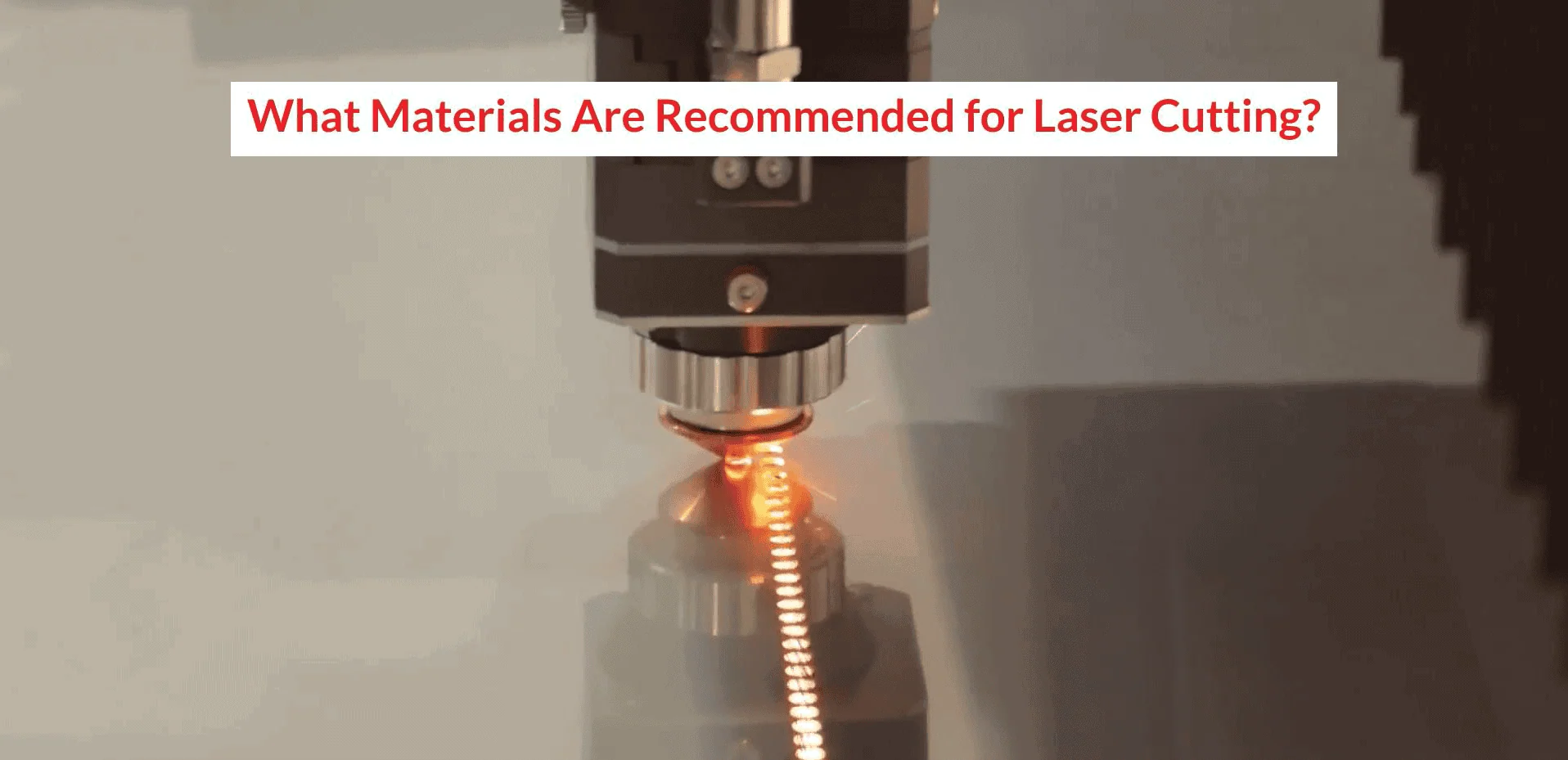
Thanks to recent advancements in laser cutting, it is now possible to cut even “difficult” materials with precision. The simplest machines can now cut large quantities of thin sheets or engrave any number of materials. Moderately powered laser cutters can be used on thin aluminum sheets, while more challenging materials like stainless steel can benefit from using more advanced machinery and cutting techniques. Today, we’re looking at the best materials to laser cut and their common uses.
What Materials Are Recommended for Laser Cutting?
Laser cutting is a precise, efficient fabrication method used to handle a variety of materials. Understanding the compatibility of these laser-cutting materials with different equipment and cutting methods is key to achieving quality results.
Metal
Metals are strong and durable, making them suitable materials for a range of laser cutting and engraving project needs. While different types of lasers can offer their own advantages, fiber lasers are generally the best option for cutting metals, as they create a precise, narrow beam that can cleanly slice through metal without excessive heat spread. These can produce precise, clean cuts during fabrication, lending to industrial applications or more intricate designs.
Steel
Steel, particularly carbon steel, is the most common material choice for laser cutting. This material is suitable for many applications, from structural components to delicate automotive parts. Carbon steel is cut using fiber lasers, which can easily manage thicker sheets. High-power fiber lasers, for example, can cut carbon steel in thicknesses at a common maximum output of 100 mm or 3.93 inches. Using an oxidation melting cutting mechanism allows operators to better control the slit of carbon steel, enabling cuts as fine as 0.1 mm.
Steel also comes in a few varieties, each with specific uses:
Cold Rolled Steel. Known for its smooth finish, colled roll steel is easy to work with and widely used in laser cutting for applications requiring precision.
Hot Rolled Steel. This is a stronger steel material, making it suitable for projects with less critical surface finish needs.
Galvanized Steel. This steel is highly resistant to corrosion. It’s frequently used in outdoor applications to promote durability in different structures.
Stainless Steel
Stainless steel is a highly versatile material, with laser-cutting applications ranging from automotive parts to advertising signage. Manufacturers can use fiber laser machines to efficiently cut stainless steel sheets and tubing. These machines give operators better control over the cutting process, significantly reducing the heat-affected zone of the cutting edge. This helps maintain the material’s corrosion resistance and mechanical properties while minimizing heat impact on the surrounding metal.
Aluminum
Aluminum is lightweight and corrosion-resistant, which is extremely valuable in aeronautics and automotive applications. However, reflective materials like aluminum can deflect laser beams due to their lower absorption rate. Small cracks can also appear on the surface when cutting certain aluminum alloys. Using fiber lasers allows operators to adjust power levels during the cutting process. Auxiliary gases such as nitrogen can be used to blow away molten material during the laser cutting process and protect the aluminum’s characteristic silvery sheen.
Brass and Copper
Laser-cut copper and brass are known for their high reflectivity and thermal conductivity, making them ideal for use in heat exchangers and various electronics. CO2 lasers are less effective at cutting reflective materials like these. Fiber lasers produce a wavelength of about 1.06 – 1.08 µm, which focuses down to a much smaller point. This results in a greater power density, allowing these lasers to cut brass and copper materials with ease.
At high power densities, copper and brass quickly reach a molten state, enabling more efficient cutting. Using nitrogen as an auxiliary gas helps maintain a clean cut without requiring oxidation.
Titanium
Titanium’s versatility and strength make it an ideal laser-cutting material for aerospace, medical, and other high-performance applications. Titanium responds well to reactive laser-cutting machines, which can convert focused laser beams into heat energy. Argon is ideal, but nitrogen can also be used as an auxiliary gas to create a rapid chemical reaction to increase cutting speeds.
Controlling the reaction is crucial to avoid oxidation at the edges. Alternatively, using air as the auxiliary gas can help prevent burning and ensure the cut edges remain clean.
PVC Coatings for Stainless Steel
Stainless steel may require a PVC coating to protect the surface during manufacturing. This PVC protects polished and finished stainless steel in certain applications, such as weatherproof paneling. However, these coatings can also emit toxic chemical fumes during cutting, posing a potential hazard to operators and the environment. In order to work with PVC-coated stainless steel, safety features such as air filtration and proper ventilation are necessary.
Laser Cutting at Evans Tool & Die
While numerous materials benefit from laser cutting, it’s important to implement specific techniques and equipment for optimal results. At Evans Tool & Die, we specialize in precision laser cutting for projects across many different industries. Our ISO 9001:2015 certification and long-running history of customer satisfaction reflect our commitment to quality and excellence. Our experienced team is here to assist with all aspects of your project, from design to assembly.
If you’re looking to streamline your production and supply chain, contact us today to receive a quote on your next laser-cutting project.
Posted by Evans Tool & Die, Inc. on | Comments Off on Progressive Die Tooling: The Backbone of Efficient Manufacturing
Click to Expand
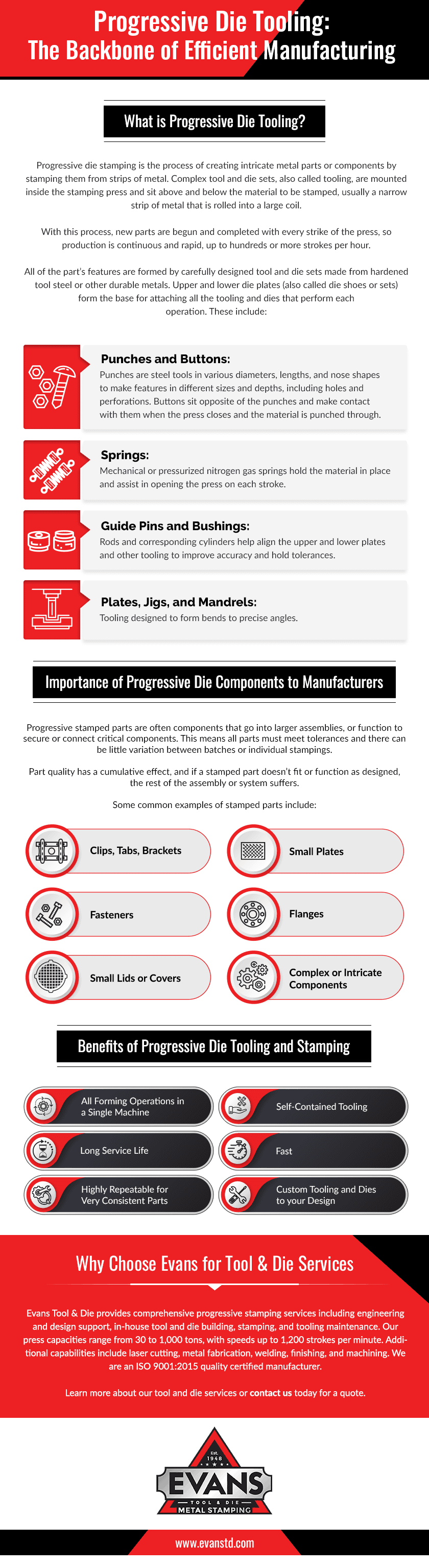
Progressive die stamping is a versatile and efficient manufacturing process for many industries. Custom tool and die sets are engineered to stamp parts from metal strips as they feed through a press.
Here, we’ll look at the progressive stamping process, the components that make up progressive die tooling, and the benefits this process offers for OEMs, their suppliers, and aftermarket manufacturers.
What is Progressive Die Tooling?
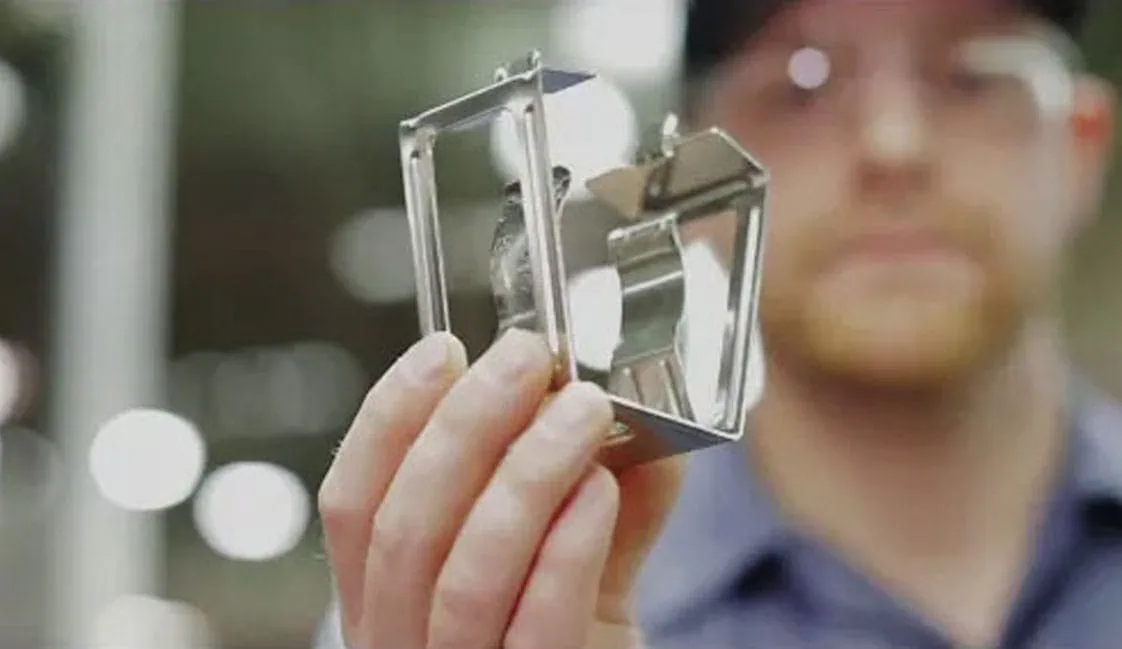
Progressive die stamping is the process of creating intricate metal parts or components by stamping them from strips of metal. Complex tool and die sets, also called tooling, are mounted inside the stamping press and sit above and below the material to be stamped, usually a narrow strip of metal that is rolled into a large coil.
The idea behind progressive stamping is that each operation required to create a finished part is laid out in sequence in a single tool and die set. The strip advances with each stroke of the press, and it stops and is struck at each station. After each stamping passes through all of the stations, they are complete with all features formed. Parts can be designed to remain attached to the carrier strip or knocked out and collected in a bin.
With this process, new parts are begun and completed with every strike of the press, so production is continuous and rapid, up to hundreds or more strokes per hour.
All of the part’s features are formed by carefully designed tool and die sets made from hardened tool steel or other durable metals. Upper and lower die plates (also called die shoes or sets) form the base for attaching all the tooling and dies that perform each operation. These include:
Punches and Buttons: Punches are steel tools in various diameters, lengths, and nose shapes to make features in different sizes and depths, including holes and perforations. Buttons sit opposite of the punches and make contact with them when the press closes and the material is punched through.
Springs: Mechanical or pressurized nitrogen gas springs hold the material in place and assist in opening the press on each stroke
Guide Pins and Bushings: Rods and corresponding cylinders help align the upper and lower plates and other tooling to improve accuracy and hold tolerances.
Plates, Jigs, and Mandrels: Tooling designed to form bends to precise angles.
Importance of Prog Die Components to Manufacturers
Progressive stamped parts are often components that go into larger assemblies, or function to secure or connect critical components. This means all parts must meet tolerances and there can be little variation between batches or individual stampings.
Part quality has a cumulative effect, and if a stamped part doesn’t fit or function as designed, the rest of the assembly or system suffers.
Some common examples of stamped parts include:
Clips, Tabs, Brackets
Small Plates
Fasteners
Flanges
Small Lids or Covers
Complex or Intricate Components
Progressive stamping works with material as thin as foil up to a half inch or more in thickness. Many grades of steel and alloys, aluminum, copper, brass, and bronze can be stamped with excellent results.
Benefits of Progressive Die Tooling and Stamping
Because progressive die tooling is custom-designed and built for each stamping project, stamping offers many benefits to manufacturers such as:
All Forming Operations in a Single Machine: There is no need to move between presses because the process moves from metal strips to completed parts as it travels through the machine. This means less handling and labor.
Self-Contained Tooling: All of the tooling and dies are attached to the plates inside the press so there is no changeover or adjustments to the tooling during stamping.
Long Service Life: Tooling and dies are usually built with tool steel or other hard, durable metals. With proper maintenance, they can last for thousands or millions of cycles. This is especially beneficial to companies that enter long-term or extremely high volume contracts, or those who have vendor-managed inventory (VMI) agreements with their stamper.
Fast: Progressive stamping presses move rapidly, with a newly completed part ejected with each stroke of the press until the batch is completed.
Highly Repeatable for Very Consistent Parts: The continuous feed of the material through self-contained tooling means variation from part to part and from batch to batch is minimal. The result is consistent quality and less scrap than other methods.
Custom Tooling and Dies to your Design: Stampers that offer in-house tooling and die design and manufacturing have a full understanding of your goals for the part and its end use. This comprehensive, end-to-end solution reduces the risk of miscommunication over the course of the project.
Why Choose Evans for Tool & Die Services
Evans Tool & Die provides comprehensive progressive stamping services including engineering and design support, in-house tool and die building, stamping, and tooling maintenance. Our press capacities range from 30 to 1,000 tons, with speeds up to 1,200 strokes per minute. Additional capabilities include laser cutting, metal fabrication, welding, finishing, and machining. We are an ISO 9001:2015 quality certified manufacturer.
Posted by Evans Tool & Die, Inc. on | Comments Off on How Tool and Die Making Works
Click to Expand
Precision tools and metal forms — known as dies — are responsible for producing most consumer equipment and products in the market. These gears are used to cut, shape, and mold metal and other materials and are made by tool and die makers.
Often known as machinists, tool and die makers use mechanical and computer-controlled technologies to precisely cut, shape, and finish tools, instruments, and metal components. In addition, they produce gauges, various measuring instruments, and jigs and fixtures, which are used to hold metal while it is being punched, stamped, or drilled.
This article will dive into the die making process and answer the question: what is tool and die work.
What is Tool and Die Making: What’s the Difference?
In the metal stamping process, nearly every mechanical instrument that cuts, forms, supports, or molds metals can be termed a tool. On the other hand, dies are a subset of tools capable of altering metals’ shapes.
So what is a die tool? A die tool is primarily used in tool and die manufacturing to shape or profile materials by cutting or forming them. Like molds, it frequently undergoes customization based on its intended use in production. There is a vast array of die-made products, ranging from simple office essentials like paper clips to more complex aviation components.
In contrast, die and tooling (also known as machine tooling) is the process of acquiring the specialized equipment and parts necessary for the large-scale manufacturing method. Effective tooling ensures the effective performance of manufactured products, prolongs product longevity, and contributes to quality improvement.
Tool and Die Makers: What Do They Do?
Tool and die makers focus on operating machinery to build tools and machine components. These specialists have received substantial training, and they advance in their careers by refining their areas of specialization and acquiring certifications. Tool & Die making is a trade skill. To achieve master toolmaker status, it takes a toolmaker 5-10 years of apprenticeship and years of hands-on experience.
Responsibilities of a Tool and Die Maker
Among their fundamental responsibilities are the following:
Reading and interpreting blueprints, sketches, specifications, or computer-aided design (CAD) or computer-aided manufacturing (CAM) files to create tools and dies
Calculating and confirming the workpieces’ dimensions, sizes, forms, and tolerances
Setting up, using, and disassembling manual, CNC, and conventional machine tools
Filing, grinding, and adjusting parts
Quality checking and testing finished tools and dies if they satisfy specifications
Buffing and polishing tool and die surfaces
Generally, machinists must possess a high school diploma or equivalent certifications. Similarly, tool and die manufacturers may be required to complete additional coursework.
Still, there are a variety of techniques for personnel to become proficient in their positions as machinists, toolmakers, and diemakers. One popular method is via on-the-job training, which usually lasts a year.
Working as a Tool and Die Maker
Most tool and die makers are employed in the manufacturing industry. They do their duties in well-lit and air-conditioned machine shops, tool rooms, and factory floors.
Although the activity is mostly risk-free, using machine tools presents some hazards. Therefore, workers must take safety precautions using protective equipment, such as safety glasses and earplugs.
In addition, tool and die makers and machinists are common in industries, including the following:
Automobile manufacturing
CNC machining
Die making
Maintenance machining
Metal die finishing
Plastic die making
Precision machining
Tool making
Machining Dies
Evans: Your Tool and Die Manufacturing Professionals
Evan Tool & Die offers a variety of solutions, including the manufacture of tools and dies. We handle everything from design and engineering to simulation testing, tool-making, and maintenance.
Our team comprises professional and seasoned tool and die makers with expertise in metal stamping, die machining services, design engineering, welding and finishing. We employ the best to offer our clients nothing less but the best!
Contact us today to book an appointment or to get a quote for your tool and die making needs!
Posted by Evans Tool & Die, Inc. on | Comments Off on What Is a Tool and Die Maker?
Click to Expand
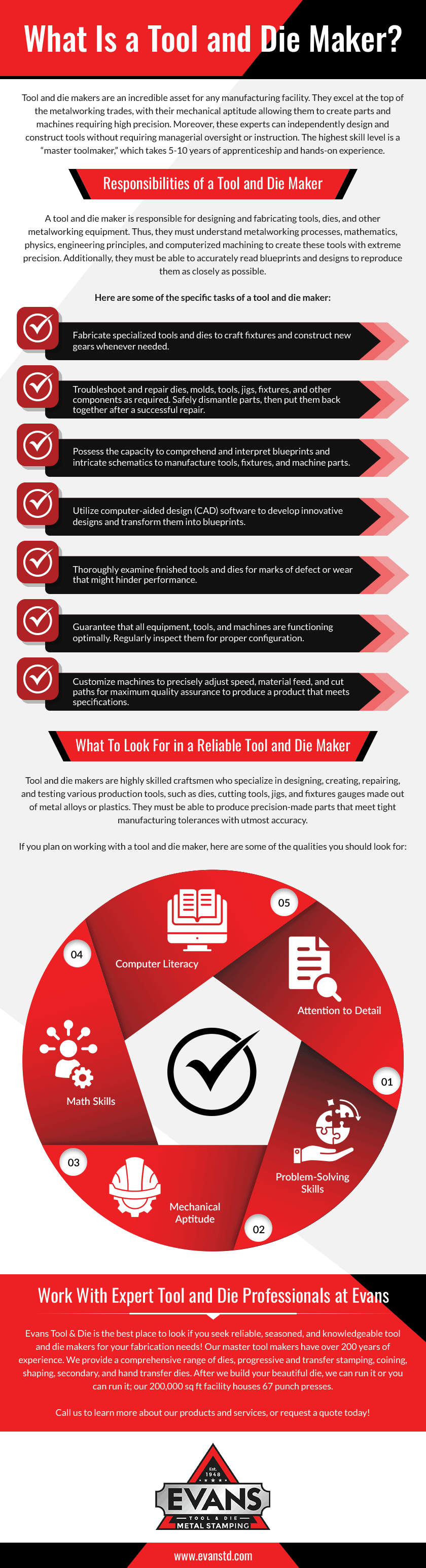
Tool and die makers are an incredible asset for any manufacturing facility. They excel at the top of the metalworking trades, with their mechanical aptitude allowing them to create parts and machines requiring high precision. Moreover, these experts can independently design and construct tools without requiring managerial oversight or instruction. The highest skill level is a “master toolmaker,” which takes 5-10 years of apprenticeship and hands-on experience.
Responsibilities of a Tool and Die Maker
A tool and die maker is responsible for designing and fabricating tools, dies, and other metalworking equipment. Thus, they must understand metalworking processes, mathematics, physics, engineering principles, and computerized machining to create these tools with extreme precision. Additionally, they must be able to accurately read blueprints and designs to reproduce them as closely as possible.
Here are some of the specific tasks of a tool and die maker:
Fabricate specialized tools and dies to craft fixtures and construct new gears whenever needed.
Troubleshoot and repair dies, molds, tools, jigs, fixtures, and other components as required. Safely dismantle parts, then put them back together after a successful repair.
Possess the capacity to comprehend and interpret blueprints and intricate schematics to manufacture tools, fixtures, and machine parts.
Utilize computer-aided design (CAD) software to develop innovative designs and transform them into blueprints.
Thoroughly examine finished tools and dies for marks of defect or wear that might hinder performance.
Guarantee that all equipment, tools, and machines are functioning optimally. Regularly inspect them for proper configuration.
Customize machines to precisely adjust speed, material feed, and cut paths for maximum quality assurance to produce a product that meets specifications.
What To Look For in a Reliable Tool and Die Maker
Tool and die makers are highly skilled craftsmen who specialize in designing, creating, repairing, and testing various production tools, such as dies, cutting tools, jigs, and fixtures gauges made out of metal alloys or plastics. They must be able to produce precision-made parts that meet tight manufacturing tolerances with utmost accuracy.
If you plan on working with a tool and die maker, here are some of the qualities you should look for:
Attention to Detail
Tool and die makers need to pay close attention to detail to ensure accuracy in their work. They must also focus on the task without becoming sidetracked, especially when dealing with complex requirements.
Problem-Solving Skills
Strong problem-solving skills are a must-have for tool and die makers. This will help them determine why a particular machine or tool isn’t functioning correctly.
Mechanical Aptitude
Mechanics are integral when designing, constructing, and repairing tools and dies. Therefore, a solid understanding of this field is essential for success as a tool and die maker.
Math Skills
Tool and die makers must have strong math skills since they often need to convert measurements from one unit of length to another when creating their tools. They also need to be able to read blueprints to ensure that the finished product meets all specified requirements accurately.
Computer Literacy
Being familiar with CAD software is key for tool and die makers since it is increasingly becoming more common in modern factories and manufacturing processes.
Work With Expert Tool and Die Professionals at Evans
Evans Tool & Die is the best place to look if you seek reliable, seasoned, and knowledgeable tool and die makers for your fabrication needs! Our master tool makers have over 200 years of experience. We provide a comprehensive range of dies, progressive and transfer stamping, coining, shaping, secondary, and hand transfer dies. After we build your beautiful die, we can run it or you can run it; our 200,000 sq ft facility houses 67 punch presses.
Posted by Evans Tool & Die, Inc. on | Comments Off on Understanding Tool And Die Engineering And Manufacturing
Click to Expand
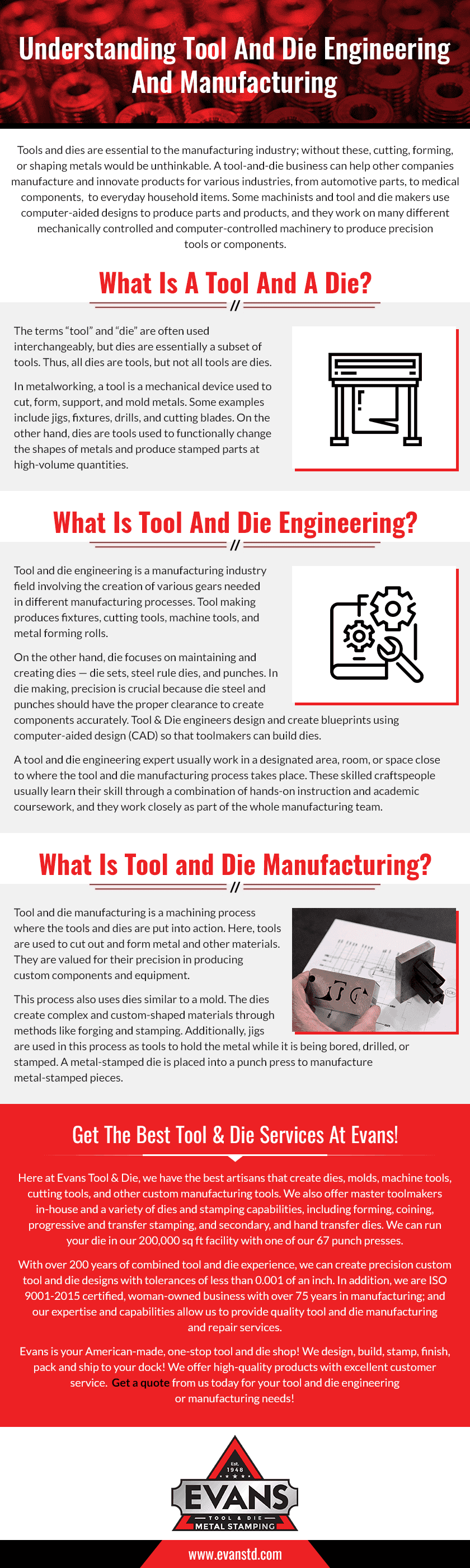
Tools and dies are essential to the manufacturing industry; without these, cutting, forming, or shaping metals would be unthinkable. A tool-and-die business can help other companies manufacture and innovate products for various industries, from automotive parts, to medical components, to everyday household items. Some machinists and tool and die makers use computer-aided designs to produce parts and products, and they work on many different mechanically controlled and computer-controlled machinery to produce precision tools or components.
What Is A Tool and A Die?
The terms “tool” and “die” are often used interchangeably, but dies are essentially a subset of tools. Thus, all dies are tools, but not all tools are dies.
In metalworking, a tool is a mechanical device used to cut, form, support, and mold metals. Some examples include jigs, fixtures, drills, and cutting blades. On the other hand, dies are tools used to functionally change the shapes of metals and produce stamped parts at high-volume quantities.
What Is Tool and Die Engineering?
Tool and die engineering is a manufacturing industry field involving the creation of various gears needed in different manufacturing processes. Tool making produces fixtures, cutting tools, machine tools, and metal forming rolls.
On the other hand, die focuses on maintaining and creating dies — die sets, steel rule dies, and punches. In die making, precision is crucial because die steel and punches should have the proper clearance to create components accurately. Tool & Die engineers design and create blueprints using computer-aided design (CAD) so that toolmakers can build dies.
A tool and die engineering expert usually work in a designated area, room, or space close to where the tool and die manufacturing process takes place. These skilled craftspeople usually learn their skill through a combination of hands-on instruction and academic coursework, and they work closely as part of the whole manufacturing team.
What Is Tool and Die Manufacturing?
Tool and die manufacturing is a machining process where the tools and dies are put into action. Here, tools are used to cut out and form metal and other materials. They are valued for their precision in producing custom components and equipment.
This process also uses dies similar to a mold. The dies create complex and custom-shaped materials through methods like forging and stamping. Additionally, jigs are used in this process as tools to hold the metal while it is being bored, drilled, or stamped. A metal-stamped die is placed into a punch press to manufacture metal-stamped pieces.
Get The Best Tool & Die Services At Evans!
Here at Evans Tool & Die, we have the best artisans that create dies, molds, machine tools, cutting tools, and other custom manufacturing tools. We also offer master toolmakers in-house and a variety of dies and stamping capabilities, including forming, coining, progressive and transfer stamping, and secondary, and hand transfer dies. We can run your die in our 200,000 sq ft facility with one of our 67 punch presses.
With over 200 years of combined tool and die experience, we can create precision custom tool and die designs with tolerances of less than 0.001 of an inch. In addition, we are ISO 9001-2015 certified, woman-owned business with over 75 years in manufacturing; and our expertise and capabilities allow us to provide quality tool and die manufacturing and repair services.
Evans is your American-made, one-stop tool and die shop! We design, build, stamp, finish, pack and ship to your dock! We offer high-quality products with excellent customer service. Have questions about your tool and die project? Contact us to speak with an expert, or request a quote for your tool and die engineering or manufacturing needs.
Posted by Evans Tool & Die, Inc. on | Comments Off on Benefits of Modern Progressive Metal Stamping and Hand Transfer Stamping in Manufacturing
Metal stamping is a type of metal working that has been around for decades. It involves shaping various metals into specific shapes or parts through multiple stages of compressive deformation. The stamping process works by applying an external force over a single work piece or metal sheet which can be made up of different alloys, each having their own degree of malleability.
Various types of metal stamping materials can be used in order to produce stamped metal parts and goods with greater strength, durability, mass-proportion, and performance without changing the weight significantly.
Stamped metal parts play a major role in today’s manufacturing
Products produced by metal stamping companies like Evans Metal Stamping, Inc are part of virtually every part of our lives where metal parts are used. From medical supply tooling to construction tools to decorative emblems and major structural components in automobile manufacturing… Metal stamping plays a major role in production.
Manufacturing has become highly specialized with the evolution of various techniques, advanced stamping presses and different materials used for stamping. By using the finest metals available for stamping, manufacturers can provide customers with high quality products in mass quantities and in a timely manner.
Most common types of metal stamping used when stamping products
The two most commonly used techniques used in modern day manufacturing are progressive die metal stamping and transfer die stamping. Both of these techniques have specific processes that make them unique. Depending on the size of stamped work piece, complexity, material and quantity needed, the manufacturer decides which technique to use.
The progressive stamping process at Evans Tool & Die
Progressive metal stamping is a manufacturing process involving the progressive deformation of an object by successively applying compressive force. It has also been known to be referred to as progressive die sinking and owes its name to the fact that it involves a series of dies (some would call them punches) which, through successive action, progressively form the product.
Stamping can necessitate low and high tonnage presses, using significant energy and large or small dies. The products are usually made from metal rolled up on heavy coils . The coiled metal is fed through the punch press and the part is stamped in progressive stages through the die that is bolted into the press. Progressive stamping will produce a significantly higher volume of parts at a much faster rate than hand transfer stamping.
At Evans Metal Stamping, Inc, we can assist with prototyping or run high volume jobs. Our metal presses can handle 30 to 1,000 tons at speeds up to 1,200 cycles per minute. When your project calls for high quality, precision stamping, Evans can handle your project no matter how big or time sensitive it may be.
Our capabilities in producing precision, high quality and high-volume runs are due to the state of the art machinery we use and our highly trained and experienced technicians. Our stamping machinery includes but is not limited to:
39 conventional presses from 30 to 1000 ton
27 high speed (1200 SPM) Bruderer presses from 40 to 125 ton
6 brake presses from 150 to 250 ton
3 shears
Hand transfer metal stamping
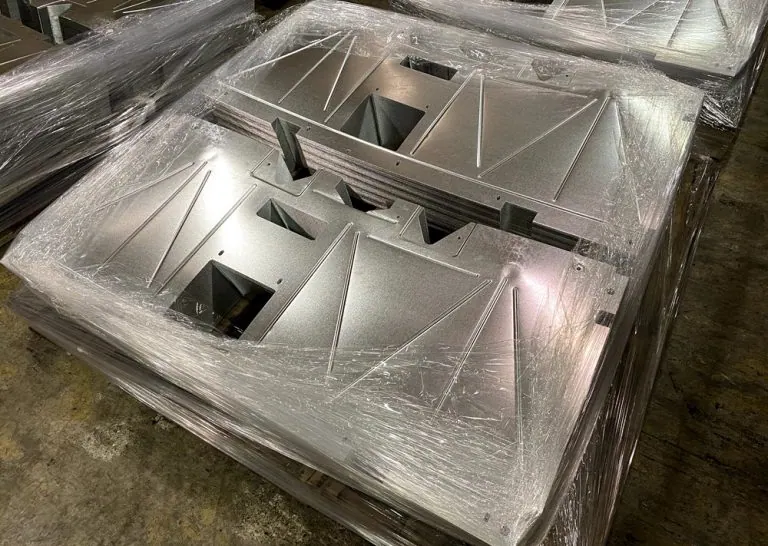
Hand transfer metal stamping is used to place individual pieces or parts of the design onto sheet metal, or stamp more heavy-duty single hit designs. Transfer die stamping is similar to progressive die stamping, but the part is free from the metal strip. Hand transfer metal stamping can also be used to add detail into already existing designs or produce larger components such as industrial generator pans which may require moving the workpiece from die to multiple dies.
Hand transfer metal stamping has been around for centuries and still used today by metal fabricators all over the world.
Evans has the capacity to produce high volumes of industrial type metal parts due to our decades of experience and machinery used to produce the parts.
Evans Metal Stamping is proudly made and produced in the USA
Evans is a one-stop shop, made in the USA, Preferred Provider of precision Tool & Die builds and progressive and hand transfer metal stamping products. We provide complete design and engineering processes, assembly, and packaging. We provide risk management solutions to the overseas supply chain breakdowns for OEMs by localizing supply chains with high quality, seamless logistics and hands on supply chain control.
Posted by Evans Tool & Die, Inc. on | Comments Off on Top Benefits of Local Sourcing
Consumer landscapes are continuing to change while businesses are adjusting for the new normal. Manufacturers and industrial companies across the world are working hard to maintain and strengthen their supply chains. And companies who preferred to source internationally to save on costs, are seeking other cost-effective solutions.
The growing reality is that procurement professionals actually prefer to source locally.
Advantages of Using Local Suppliers
It’s clear that most buyers prefer to keep the supply chain as close to home as possible. Here’s why:
More Flexibility. Local suppliers are typically more reactive than suppliers who are farther away. They can deliver products quicker, and it is much easier for a supplier to coordinate a shipment across the neighborhood than around the world.
Greater Control. The further away you are from elements of your supply chain, the less control you have over them. Face-to-face visits will allow you to address any concerns and ensure all products meet your standards. There’s also less chance of things getting “lost in translation,” which often occurs when working with big teams of people, many of whom aren’t actually on the floor and touching your products.
Reduced Supply Chain Costs. North American businesses send and receive parts and products all over the continent and the expenses can add up as quickly as the miles. Even then, these pieces have to be stored in warehouses until they are shipped again to the next supplier or, if you’re lucky, the customer. Many of these costs can be reduced by localizing your supply chain. And, with less money being sunk into logistics, there will be less weighing down your bottom line.
More Revenue. Local sourcing doesn’t just help save money; it can also help you generate more of it. That’s because companies in your region may be impressed by your efforts to keep a tight and fast-paced supply chain, which can help you attract new customers.
Good for the Community. It stands to reason that if sourcing locally increases your bottom line, it would do the same for other suppliers and manufacturers in your area, which can be a big boon to your local economy and the people who live there.
Happy, well-paid employees are more likely to invest in local businesses. Additionally, respected and well-off businesses are in a position to contribute to communities through fundraising, volunteering, benefits, and sponsored activities.
It Helps the Environment. Localizing your supply chain represents a tremendous opportunity to help the environment. When you reduce shipping and storage, you also reduce emissions and energy usage. Sourcing locally not only contributes to green manufacturing, but ultimately helps you build consumer confidence. When consumers buy with confidence, the business benefits from increasing positive brand awareness and customer loyalty.
Ability to Launch Products Faster. Manufacturers who source locally benefit from working with companies in the same time zone, which leads to easier and speedy communication. You can resolve problems faster and launch products to meet consumer demands and spikes.
Posted by Evans Tool & Die, Inc. on | Comments Off on How the Toolmaker Apprentice Program has Changed in 50 Years
This article is the second installment of three articles about Toolmaker Apprenticeships. In the first article, we discussed the basic structure, time, requirements, and expected outcome from an individual’s journey through an apprenticeship. In this post, we’re taking a deeper look at how a Toolmaker Apprenticeship has changed since the 1970s.
What has changed?
To learn what has changed since Apprenticeship programs in the 1970s, we talked with Ronald Joseph and Robert Tiller, both long time journeymen in the Tool & Die trade. Though we spoke with each of them at separate times, they agreed on what has changed and what has stayed the same.
The training – When Ronald Joseph began his apprenticeship program, he went to school one day each week. Every Monday, he and his fellow apprentices would get two hours of class time and then three hours of shop time, learning the very basics of the machines and tools. Today, when the “kids” start right out of high school, it’s all OTJ – on the job training.
The tools – When Ronald Joseph started, they made their tools by hand using a file. “They sure don’t do that anymore!”, said Ronald.
The maintenance – One of the first thing that both Ronald and Robert Tiller learned when they started was how to sharpen – by hand using a pedestal grinder – the tool bit. Today’s tools are coated, and are designed to last longer.
The technology – Back in the 1970s and 1980s, when a customer would provide a drawing, a toolmaker had to make the decision, based on experience only, the best way to make a part. Today, the drawings are all electronic, and computer software can quickly determine the best methods and materials to use.
The machines – From CNC machines to Electric Wire Cutting Machines, the speed and accuracy of how things get built on the shop room floor are very different today than they were 30, 40, or 50 years ago.
What’s still the same?
Despite all the advances in technology that allow experienced toolmakers to do things better and faster, some things haven’t changed. Both Robert and Ronald believe these things won’t change.
Time – It still takes 4 to 5 years for an apprentice to learn all the tools, machines, safety precautions, materials, speeds & feeds before that apprentice can turn a block of steel into a die to make a part.
Safety first! – The machines are bigger, faster, more powerful, and therefore even more dangerous than they were 50 years ago. The first rule of being a Toolmaker Apprentice was safety first back then, and it’s safety first today.
Math – The fact that a toolmaker has to know trigonometry will baffle a lot of people, but the math never changes.
Much has changed, and much has stayed the same in a Toolmaker’s Apprentice world. Evan still retains more than a dozen Toolmakers and a constant flow of apprentices to learn and eventually lead the operation at Evans.
In the next and final article on Toolmaker Apprenticeships, we will meet each of the Apprentices employed at Evans Tool & Die.
Posted by Evans Tool & Die, Inc. on | Comments Off on The Modern Day Toolmaker Apprentice Program
In this three part series, we examine the age old approach to job training called the apprenticeship. Through interviews with Toolmakers, Master Toolmakers, current and recent apprentices, we discover what it means to be a Toolmaker Apprentice today and what has changed in the last generation of Toolmakers.
What is an Apprenticeship?
Wikipedia provides a solid definition of “apprenticeship”: An apprenticeship is a system of training a new generation of practitioners of a trade or profession with on-the-job training and often some accompanying study (classroom work and reading). Apprenticeship also enables practitioners to gain a license to practice in a regulated profession.
This definition fits well with what we learned from our conversations with six Evans employees. As we will discuss later in this article, the requirements of an Apprentice changed significantly since the 1970s. However, the approach remains the same. An apprenticeship program trains and educates someone with little or no experience into a professional at the trade.
What qualifications are required to become a Toolmaker Apprentice?
Generally speaking, there are no strict requirements for becoming a Toolmaker Apprentice. The candidate must be old enough to work full time job in their state. Aside from that, our conversations revealed some interesting answers.
Dick Ankeny, Shop Supervisor, started in High School. Ankeny’s Junior and Senior years in High School included machine shop classes that got him interested in machining and toolmaking. Ankeny offered the following as “what it takes” to be an apprentice, as opposed to any hard requirements:
Solid math skills – “trigonometry plays a big role in building tools and dies”
A desire to do this trade – “you’ll know within about 6 months if this is for you.”
A desire to create new things – “you start with a block of steel.”
How long is an apprenticeship to be a Toolmaker?
A new Toolmaker Apprentice should expect to be an Apprentice for about five years. It may be more or less than that, but with that expectation in mind, the Apprentice will be in the correct mindset to learn a great deal of skills and information in the early part of their career.
What does a Toolmaker Apprentice learn?
Starting on Day One of an Apprenticeship, the new Apprentice should expect to be in 100% learning mode. The Apprentice will learn most of the following items fairly quickly.
How to read a blueprint – the blueprint is the engineer’s drawing of what the part should look like.
How to square a block – The Apprentice must put a raw piece of steel in the mill, and get it square down to the thousandths of an inch according to the dimensions on the blueprint.
Drilling & Tapping – generally, how to use the most basic machines.
“Speeds & feeds” for lathe and mill – the speed at which the lathe and miller are operating and how fast one feeds in the steel into the lathe or mill. One can gain such knowledge through experience.
Leave .002” grind stock on the block – this requirement comes from the fact that, after the steel is heat treated, you still need some room on the block to make adjustments.
Heat buildup – When Start grinding, you must monitor heat buildup because the metal can warp if it gets too hot
How fast one catches on to each concept determines the Apprentice’s progress. The number one rule, lesson, and learning point for any Apprentice is safety first.
In the next installment of this series, we will compare and contrast the Apprenticeship experiences of a Toolmaker who completed his Apprenticeship 30 years ago and a Toolmaker who completed his Apprenticeship within the past 12 months.
Evans Companies, Inc uses cookies to give you a more personalized experience on our website. If you continue to use our services, we assume that you accept such use. Learn more about cookies and how you can refuse them on our Privacy Policy page.