The same precision, held to your industry's standard.
From surgical instruments to defense hardware to highway signage, Evans has built parts for the industries that build America since 1948, one domestic source, held to one quality system.
01 / 08
Medical
Error-free components where failure isn't an option.
Medical device manufacturers need suppliers who improve product quality while holding costs, and who never ship a defect. A failed component can mean a recall, or worse, harm to a patient or clinician.
Every medical stamping Evans produces is made with precision, close attention to detail, and advanced quality controls, backed by ISO 9001:2015 and material traceability. In-house tool and die means we can hold complex geometries and scale from prototype to full production.
Avoid expensive recalls · Uphold your reputation · Protect your margins
Medical instrumentation metal fabrication demands precision, traceability, and single-source accountability. At Evans Tool & Die, we manufacture metal components for diagnostic equipment, laboratory systems, and healthcare devices. Through high-precision stamping for diagnostic equipment combined with in-house tooling and secondary operations, our Conyers, GA facility eliminates hand-offs between tool shops and production floors.
The Advantage of In-House Tool and Die for Complex Geometries
With over 200 years of combined experience, the master tool makers at Evans tackle complex medical equipment housing design without external shop dependencies. Integrating these steps directly into the workflow cuts weeks from development timelines.
In-house tool and die for medical components means absolute control over clearances, punch wear monitoring, and die maintenance schedules. When diagnostic instruments require brackets with ±.0005 in. positioning accuracy, tool makers build those exact specifications into the progressive dies.
During forming operations, DFM for medical equipment housings addresses crucial material flow dynamics. Tool designers proactively account for springback, grain direction, and surface finish requirements specific to medical applications.
Quality Assurance: ISO 9001:2015 and Material Traceability
To ensure consistent process stability, inspectors execute first-article verification, 30-minute in-process checks, and complete final part evaluations before packaging. Statistical process control continuously tracks critical dimensions.
Maintaining strict compliance for medical OEMs requires rigorous, documented systems:
- Material traceability in medical manufacturing. Tracking starts with certified mill test reports. Lot numbers link finished components back to the original coil for device master files and regulatory submissions.
- ISO 9001:2015 certified medical stamping. Documented procedures establish baseline process controls and fuel continuous improvement. Incoming material inspection consistently verifies chemical composition and mechanical properties before production begins.
Scaling Production From 30 to 1,000 Tons
Scaling from 30 to 1,000 tons, the press floor accommodates everything from small internal brackets to large medical frame assemblies requiring 800-ton forming forces. Progressive die stamping for medical assemblies achieves speeds up to 1,200 strokes per minute when part geometry allows automated feeding.
High-tonnage equipment also brings economic benefits to multi-part medical kits, allowing several components to nest together in a single progressive die. This approach maintains consistent dimensional relationships between mating features. For example, 1,000-ton presses provide high-precision stamping for diagnostic equipment enclosures while keeping springback to an absolute minimum.
Beyond Stamping: Laser Cutting and Robotic Welding
Providing full-service fabrication extends beyond the press floor. Evans offers specialized secondary operations tailored to complex medical manufacturing:
- Custom laser cutting for medical instruments. This process handles low-volume prototype runs and geometrically complex parts. A 6kW fiber laser cuts stainless steel with accuracy, holding ±.0005" to ensure precise edge profiles.
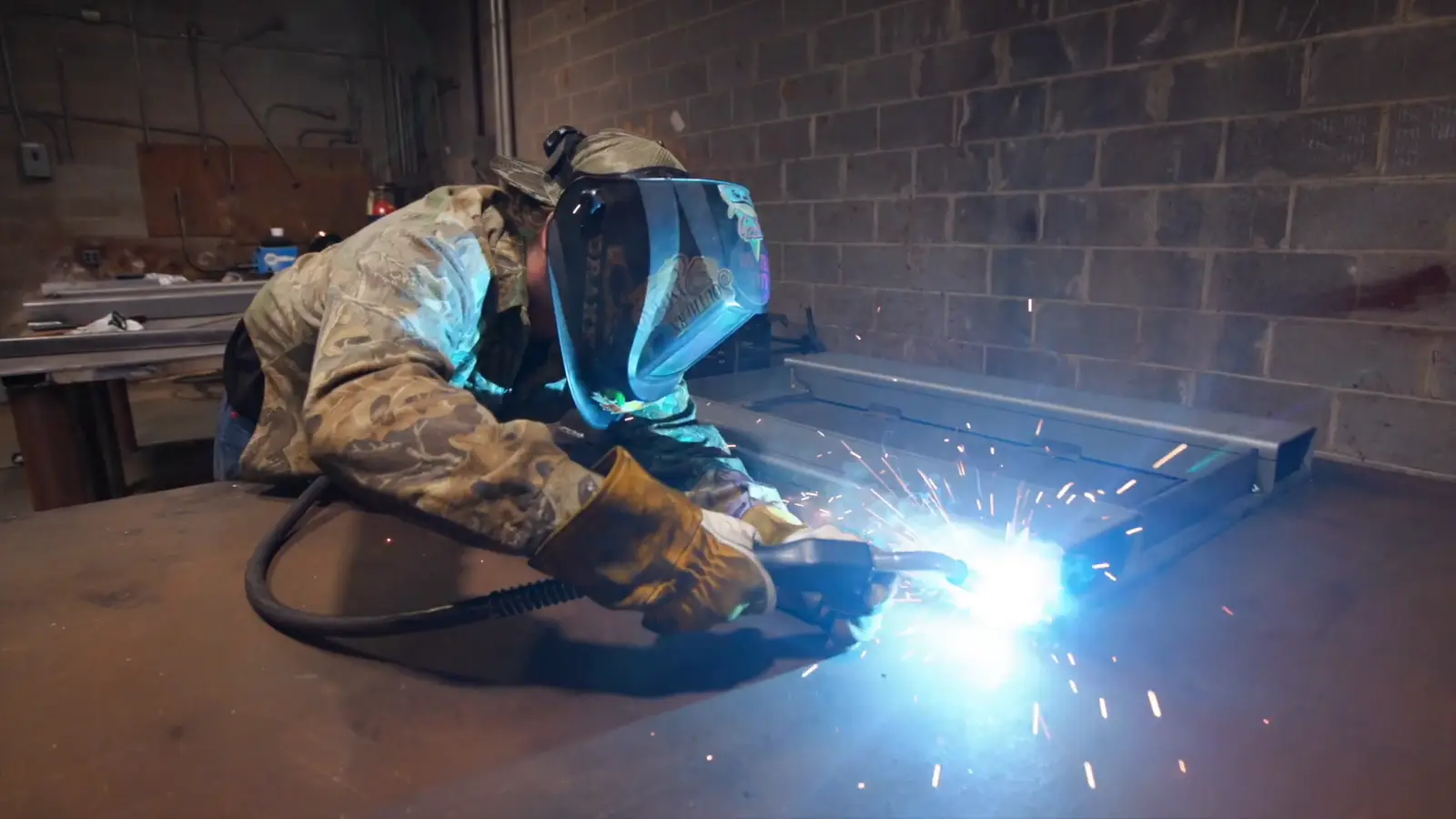
- Robotic welding for medical device fabrication. Automated systems deliver consistent penetration and minimal distortion. Programmed weld paths for MIG and TIG processes produce assemblies with highly repeatable bead profiles.
- Material selection guidance. Choosing between types of stainless steel for medical devices presents a key design trade-off. Some types offer excellent formability for deep-drawn components, whereas others provide superior corrosion resistance in surgical environments exposed to chloride-containing fluids.
Medical Instrumentation Fabrication
Partnering with a single-source manufacturer reduces lead times and eliminates coordination risk. By combining in-house tool and die for medical components, high-precision stamping for diagnostic equipment, and secondary operations under one roof, Evans protects your supply chain. Material traceability in medical manufacturing and ISO 9001:2015 certified medical stamping confidently support your device development from prototype through full production.
02 / 08
Military & Defense
Mil-Spec and ITAR-aware, built for the harshest conditions.
Components for military and defense applications must perform in a broad range of operating conditions and meet strict requirements. Evans has the equipment and processes to produce defense stampings that are cost-efficient, defect-free, and compliant.
From initial concept and design through tooling, prototyping, and full production runs, we support the administrative and operational needs of defense programs as a domestic, single-source manufacturer.
ITAR status is being confirmed. Ask our team about current registrations.
Developing metal stampings for the military involves understanding each client's unique operational and administrative environments. In doing so, Evans Tool & Die provides top-quality, cost-effective metal stampings free of defects. With our cutting-edge equipment and expertise, we support military projects at every stage of the stamping and fabrication process, from design and tooling to prototyping and production. Our custom metal stamping services comply with Mil-Spec and ITAR requirements and perform optimally in harsh conditions.
Benefits of Custom Military & Defense Fabrication
As a leading metal stamping parts supplier, we provide military and defense fabrication solutions with the following key advantages.
Complex Geometries
Many types of military and defense equipment need components with complex designs. In custom fabrication, our experts fabricate accurate parts with complex geometries and tight tolerances.
Consistency
Our metal fabrication capabilities also offer repeatability and precision across all parts, regardless of the scope of the production run. We adhere to your specifications with each component, allowing for optimal interchangeability.
Material Selection Expertise
Custom metal fabrication is compatible with a wide range of material types. Whether you need high heat resistance, strength, or other critical properties, we'll choose the right materials for your components.
Rapid Prototyping
Military and defense applications need fast prototyping to keep up with the evolving technology in this industry. Our rapid prototyping services can efficiently develop and test your designs, accelerating your product's time to market.
Customization
We design and develop custom solutions for your application's particular requirements, ensuring you get products that perform with optimal efficiency.
Improved Performance
Compared to off-the-shelf components, our custom metal fabrication solutions can improve overall performance in your application.
Enhanced Safety
We develop solutions that adhere to your defense application's safety standards and regulations. This lowers the risk of accidents and saves lives.
Cost-Effectiveness
While the initial cost of custom metal fabrication is generally higher than that of standard solutions, you'll benefit from long-term cost savings. Since custom solutions are tailor-fit to your application, you can save more money on maintenance and replacements.
Types of Custom Military & Defense Fabrication Components We Offer
As a premier defense components manufacturer, Evans Tool & Die understands that every solution for military and defense contractors needs to work flawlessly in a range of challenging operating environments. We most frequently fabricate components used in the following products:
- Connectors
- Caps
- Couplings
- Fittings
- Housings and enclosures
- Sleeves
- Shells
- Sensors
Other examples of custom military and defense parts we develop include:
- Clips
- Fuse boxes and clips
- Brackets
- Housings
- Hose clamps
- Compression limiters
- Press-fit pins
- Inserts
- Selective plated lead frames and terminals
- Rolled bushings
- Lead frames
- Lighting components
- Terminals, connectors, and contacts
- Crush bushings
- Shields
- Sensor components
- Wire and cable connectors
- Transmission lead frames
Evans Tool & Die: A Trusted Military & Defense Components Manufacturer
As a metal stamping parts manufacturer, Evans Tool & Die has the equipment and expertise to produce defect-free, cost-effective components for military and defense contractors. Our parts comply with ITAR, Mil-Spec, and other client-specific requirements as needed. In addition to the military, we serve the medical, automotive, construction, furniture, appliance, and other industries.
To provide a complete solution, we offer the following key capabilities:
- Initial concept and design
- Tooling
- Prototyping
- Full production runs
03 / 08
Automotive
Tight-tolerance parts at production volume.
The automotive industry runs on metal stamping. Using specialized dies, Evans produces components with extremely tight tolerances, cutting and forming the workpiece to exact size and shape at the volumes production demands.
RVs, ATVs, and commercial vehicles depend on the same repeatability and precision for a broad range of critical components and accessories.
Metal stamping for the automotive industry is a critical process that transforms flat metal sheets into precise, complex vehicle components for structural, functional, and aesthetic purposes. At Evans Tool & Die, we specialize in producing custom, high-volume solutions for our automotive customers. We use advanced technologies such as deep drawing, progressive die stamping, and transfer stamping to meet tight tolerances. Our fabrication solutions address the growing demand for lightweight, durable, and seamlessly integrated automotive components.
Benefits of Custom Automotive Metal Stamping
Custom automotive metal stamping from Evans Tool & Die offers manufacturers full control of the design process, which leads to improvements in the following areas of production:
- Precision and accuracy. Our custom designs meet strict tolerances and specifications to make sure all components perform as intended.
- Cost-effectiveness. The scalable process of custom metal stamping can reduce material waste, optimize resources, and lower production costs.
- Durability. Our parts are engineered for reliable, long-lasting performance under extreme conditions.
- Design flexibility. Custom metal stamping lets us create intricate shapes and complex geometries to meet any design need while adhering to industry standards. The customization process produces innovative part designs that reduce vehicle weight, improve fuel efficiency, and enhance safety standards.
- Material versatility. We offer many material options, including lightweight aluminum, stainless steel, and high-strength steel.
The Automotive Stamping Process
At Evans Tool & Die, our automotive stamping process ensures precision, quality, and efficiency through the following steps:
- Tooling design. Each project begins with custom die and tool engineering tailored to your exact specifications.
- Material selection. We'll choose the best metals for the project based on strength, weight, and corrosion resistance needs.
- Stamping. We use advanced techniques like progressive and transfer stamping to deliver high-quality, consistent parts at scale.
- Secondary processes. Our team offers additional services to complete components, including welding, surface treatments, and assembly.
- Quality assurance. We conduct rigorous inspections at every stage to ensure all parts meet industry and client-specific standards.
By integrating cutting-edge technology with skilled craftsmanship, our stamping process helps manufacturers meet production timelines without compromising quality or performance.
Types of Automotive Stampings We Make
Evans Tool & Die produces a diverse range of components for automotive applications, optimized for safety, cost-effectiveness, and performance:
- Structural components: body panels, chassis supports, structural reinforcements
- Functional parts: suspension systems, heat shields, exhaust components
- Hardware: brackets, fasteners, clips
- Interior systems: parts for dashboards, seats, and doors
- Drivetrain components: transmission and suspension parts
Applications of Automotive Metal Stamping
Automotive metal stamping produces critical parts for all types of vehicles, including:
- All-terrain vehicles (ATVs). Durable and lightweight components such as skid plates and brackets enhance performance in rugged environments. We typically fabricate these components from high-strength aluminum.
- Commercial vehicles. We produce heavy-duty chassis supports and load-bearing brackets from high-strength steel to withstand extended operational lifespans.
- Passenger vehicles. We design precision-stamped parts, including exhaust shields, body panels, and dashboard reinforcements, to improve fuel efficiency and meet strict safety standards.
Learn More About Quality Automotive Stamping Parts by Evans Tool & Die
At Evans Tool & Die, we combine decades of experience with a relentless focus on innovation, ensuring our solutions stay ahead of industry trends. Our precision-crafted parts are designed to integrate seamlessly into modern automotive systems while meeting the highest standards of durability and efficiency. We use cutting-edge technologies and a customer-first approach to deliver low- to high-volume solutions that drive safety and performance.
04 / 08
Metal Signs
Custom laser-cut signage, brand marks, and decor.
Evans laser-cuts custom metal signs for business branding, logo signs, office decor, outdoor signage, and personalized projects. Send an image of where the piece will go and our design team sizes it to the space, providing a 3D rendering of the final look before we cut.
It's the most accessible way to experience Evans laser precision, and a showcase of what the fiber laser can do with intricate detail.
Make your signage and custom architectural details stand out with custom laser cut steel and metal products from Evans Tool & Die, Inc. and Evans Metal Stamping, Inc. Laser cutting technology offers an optimal balance between custom creative expression, precision manufacturing, and cost-effective production. See how our laser cutting services can bring your design to life with precise, computer-controlled cutting and shaping.
About Custom Laser Cut Metal
Laser cutters are precision cutting tools that use a concentrated beam of heat and light to remove material and cut through sheet metal. Cuts are clean and smooth and create less material waste compared to other methods. Because the laser is CNC-controlled, its path follows the pre-programmed design file precisely, eliminating variation and errors common in manual processes.
Benefits of Custom Laser Cut Metal Signs
Investing in custom laser cut metal signs has several advantages, including:
- Creative Potential. Today's lasers can produce wide, narrow, or detailed cuts and designs like etching and engraving letters, logos, graphics, and borders. The creative possibilities are endless thanks to advanced laser technology.
- Durability. Sheet metal is strong and resistant to harsh outdoor and indoor conditions including heat, rain, snow, UV light, and abrasion. It withstands stresses that damage other materials like plastic, vinyl, and wood. Metal is also resistant to fading and can be coated for weather and corrosion resistance.
- Precision. Advanced laser cutting tools are more precise, with the ability to achieve tight tolerances and intricate images.
- Versatility. At Evans, we provide laser cut signage, architectural components, exterior decorative fixtures, and more, using a variety of metal materials.
- Eye-Catching Aesthetic Appeal. The smooth lines and eye-catching finish of a metal sign attracts attention and displays your branding with style. Laser cut or engraved metal also makes safety, directional, or informational signs that are easy to spot and read. Signs can also be plated, painted, and powder coated for long-lasting visual appeal.
- Reduced Maintenance. Properly cut and sealed metal signs require little upkeep, especially when coated for weather resistance.
Types of Custom Laser Cut Metal Signs We Make
Evans specializes in custom metal signages for just about any application. We serve hobbyists, as well as municipal, commercial, and industrial organizations with options including, but not limited to:
- Exterior and Interior Store Signs
- Traffic and Directional Signs
- Monument and Building Plaques
- Entrance Signs for Buildings, Shopping Centers, and Facilities
- Special Event and Custom Signage
- Commemorative Plaques
Custom Laser Cut Metal Signs and Fabrication From Evans Tool & Die, Inc. and Evans Metal Stamping, Inc.
When it's time for a custom sign or other metal architectural detail in your next project, don't settle for generic signage. Instead, consider investing in a beautifully designed and laser cut metal piece from Evans Tool & Die, Inc. and Evans Metal Stamping, Inc. We've been serving customers for over 75 years, and all of our signs are made in-house here in the United States.
05 / 08
Construction
Durable, cost-efficient parts at real production speed.
Builders, framers, and structural engineers need durable, reliable, labor-efficient solutions. Metal stampings are integral to construction for their strength, sustainability, and flexibility across end applications.
Evans has supplied the commercial and residential construction industries for over 70 years, delivering parts with high accuracy, strength, and output from state-of-the-art equipment and skilled operators.
In the construction industry, builders, structural engineers, and structural framers choose materials that are strong and durable for supporting loads in buildings and structures. Cost-effectiveness and ease of installation are also important for using resources efficiently and meeting project timelines.
At Evans Tool & Die we provide metal stamping and laser cutting services for many construction applications from building materials to equipment parts and beyond. Learn more about our capabilities and services for the construction industry as well as some common applications of our work.
Precision Metal Stamping and Laser Cutting for Construction Components
Many types of metal structural elements, fastening and support components, and parts used in power tools are fabricated with metal stamping and laser cutting processes. Both of these high-precision operations are quick, repeatable, and known for efficient use of materials.
In construction applications, it's important for materials to be uniform and manufactured to meet OEM and customer requirements so that structural pieces fit correctly in framing assemblies, brackets hold pieces in place without torquing, and tool parts stand up to heavy use and jobsite wear and tear. Therefore, the ability to stamp and cut components to specified dimensions with necessary part features is critical.
The Benefits of Metal Stamping and Laser Cutting for Construction Applications
Both metal stamping and laser cutting offer numerous advantages in the construction industry.
Metal Stamping
Metal stamping uses cutting tools and dies mounted into a high-tonnage stamping press. As the upper tooling moves downward onto a sheet or strip of metal, specific shapes and features are formed. Material is held in close alignment throughout the process, which results in high accuracy and repeatability cycle after cycle. Evans manufactures all tooling and dies in-house. Some of the benefits of stamping components include:
- Strength and durability. Metal stamping is compatible with many types and thicknesses of material including alloys, steel, and aluminum. As a result, it's possible to fabricate a range of part types from very small delicate and intricate brackets to heavier yet simple shapes.
- Accuracy and precision. Metal stamping tooling and guiding elements are designed and manufactured to make the specified part features within very tight tolerances, so there is little variation between parts. This means assemblies fit together better, features like notches and holes are aligned correctly, and components are highly uniform.
- Cost-effectiveness. Metal stamping is cost-effective thanks to its very low error rate, which results in less scrap and wasted material. Stamping is suitable for both low- and high-volume production, and it requires less energy and labor than machining and alternative processes.
- Versatility. There are many different stamping operations, from shearing and blanking to piercing, bending, notching, and others. This means it can be used to form a wide range of parts efficiently and reliably. Stamping is also suitable for highly customized parts and components.
Laser Cutting
Laser cutting uses a computer to guide a powerful laser along a predetermined cutting path. It makes precise, clean cuts that need little to no additional finishing. It offers these advantages:
- Accuracy and precision. Laser cutting offers a combination of precision and accuracy with every cut, which is necessary in construction for developing parts with tight tolerances and complex designs. Laser cutting is also highly repeatable because all of the laser's movements are controlled by computerized work instructions.
- Efficiency and speed. The laser's power and the speed of the arm holding it can be adjusted to best suit the type and thickness of the material being cut. This means laser cutting is very fast, but it can also be slowed down when necessary to maintain clean cut edges and tolerances, depending on the material and component in question.
- Material versatility. Lasers can be used to cut many different materials including steel, stainless steel, aluminum, and wood.
- Minimal material waste. In laser cutting, the layout of how pieces are cut out of a sheet of metal is designed to generate minimal waste. The goal is to get as much from each sheet of material as possible.
Construction Industry Applications
Metal stamping and laser cutting are useful processes for many applications in or related to the construction industry.
Steel Pallets
The interlocking pieces of a steel pallet can be laser cut for clean cut edges and precise dimensions that assemble easily.
I-Beams
Also called H-beams with an H-shaped cross section, I-beams consist of a vertical "web" and "I"-shaped flanges. Lasers can be used to cut holes and other features into them for use with fasteners in structural assemblies.
Brackets and Connectors
Truss plates, joist hangers, gang nail plates, and other types of brackets and connectors can be stamped from steel or other metals.
Equipment Parts
Many of the parts used in construction equipment are stamped or laser cut, including components in frames, fuel tanks, heat shields, enclosures, tank straps, and toggle switch guards.
Power Tools
Some of the parts in saws, grinders, and drills are manufactured by stamping or laser cutting. Jigs and other devices used with them may contain stamped parts also.
Your Trusted Fabricator for Construction Applications
Evans Tool & Die is a trusted supplier of custom metal stampings and laser cutting services for customers in the construction industry. We also provide welding, machining, sheet metal fabrication, finishing, and engineering support for a complete solution for your custom manufacturing projects.
06 / 08
Furniture
Industrial-strength stamped and welded components.
Evans works closely with furniture OEMs to supply high-quality metal-stamped parts and assemblies known for their strength, accuracy, and reliability. Major furniture brands trust Evans components in their products.
Our capabilities span heavy weld fabrication, large deep-draw stamping, laser-cutting prep, progressive stamping, and robotic welding, formed from aluminum, brass, copper, cold-rolled, draw-quality, and stainless steel.
In the highly competitive commercial and residential furniture manufacturing sectors, the underlying structural integrity and aesthetic finish of every piece depend heavily on the quality of its components. Evans Tool & Die works closely with the furniture industry to supply high-quality, precision-engineered metal-stamped parts.
Furniture OEMs rely on Evans Tool & Die for stamped and fabricated metal components designed for structural strength, dimensional consistency, and repeatable production performance. Our stamping and fabrication capabilities support both high-volume furniture production and custom component requirements.
Precision Metal Capabilities for Furniture OEMs
Meeting the stringent scale, timeline, and design requirements of modern furniture manufacturing demands advanced technology and proven expertise. Evans Tool & Die provides metal stamping, fabrication, and laser cutting capabilities designed to support the production volume, tolerances, and design requirements of furniture manufacturers.
- Progressive Stamping: Supports high-volume production of brackets, hinges, structural connectors, and other repeatable furniture hardware components.
- Large Deep Draw Stamping: Used to form seamless or complex shapes such as chair bases, decorative caps, and formed housing components.
- Heavy Weld Fabrication & Robotic Welding: We deliver industrial-grade strength for heavy-duty commercial furniture framing and load-bearing structural supports. Robotic welding supports repeatable weld quality across large production runs.
- Laser Cutting Preparation: Providing exact dimensional tolerances and exceptionally clean edges, laser cutting supports intricate exposed metal designs that require clean edges, dimensional accuracy, and consistent repeatability.
High-Strength Materials Built to Last
The material selection for any furniture component directly impacts both the aesthetic finish and the overall load-bearing capacity of the final product. Evans Tool & Die is equipped to form and manipulate a wide array of high-strength materials to match your specific engineering requirements.
- Aluminum & Brass: Lightweight and corrosion-resistant materials are commonly used in decorative furniture components and outdoor applications.
- Cold-Rolled & Draw Quality Steel: Provides tight thickness tolerances and consistent formability for structural and cosmetic furniture components.
- Stainless Steel & Copper: Commonly used for exposed furniture components that require corrosion resistance and durable surface finishes.
- Sheet Metal: A highly versatile and cost-effective solution tailored for creating internal framing, hidden supports, and reliable structural backings across various furniture lines.
Why Choose Evans Tool & Die for Your Furniture Components?
Supply chain reliability and consistent part quality are non-negotiable for furniture OEMs. With decades of industry experience, Evans Tool & Die understands the unique pressures of furniture manufacturing. Evans Tool & Die supports furniture manufacturers with scalable production capabilities, controlled manufacturing processes, and tight tolerance requirements. Our team focuses on dimensional consistency and repeatable production to support efficient downstream assembly.
Bring Your Furniture Designs to Life
Whether your latest product line requires high-volume progressive stamping for hidden structural hardware or precision laser cutting for striking exposed frames, Evans Tool & Die is ready to deliver. Work with a fabrication partner experienced in supporting the production demands of commercial and residential furniture manufacturing.
07 / 08
Appliances
Functional and attractive, built to last.
The appliance industry relies on parts that are long-lasting and reliable. From electrical sockets to lighting fixtures, metal-stamped parts are essential to household and commercial appliances.
Evans understands these components must be both functional and attractive, and we finish our stampings to look as good as they perform for residential and commercial appliance makers alike.
The appliance and lighting industries rely on high-performance parts that are both long-lasting and exceptionally reliable. From electrical housings and mounting brackets to decorative lighting assemblies, stamped metal components play a critical role in appliance and lighting manufacturing. Evans Tool & Die manufactures precision metal stampings and fabricated components designed to meet both functional performance requirements and cosmetic finish standards.
Advanced Fabrication Capabilities for the Appliance Sector
To meet the rigorous demands of commercial and residential appliance manufacturing, your supply chain requires a partner with diverse, scalable capabilities. We leverage advanced technology to produce components with exact tolerances and superior durability. Our core metal stamping and fabrication capabilities include:
- Heavy Weld Fabrication: Used for structural frames and heavy-gauge assemblies in commercial appliance and industrial equipment applications.
- Large Deep Draw Stamping: Supports the production of seamless appliance housings, drums, and lighting reflectors while maintaining material strength.
- Laser Cutting Preparation: Supports tight tolerances and clean edge quality for complex appliance and lighting components prior to forming or assembly.
- Progressive Stamping: Highly efficient, cost-effective, and high-volume production designed for smaller, repetitive parts like electrical contacts, mounting clips, and brackets.
- Robotic Welding: Provides consistent, repeatable weld quality for high-volume appliance and lighting assemblies.
High-Strength Materials for Lighting and Appliances
Selecting the optimal material is critical for managing thermal conductivity, ensuring electrical safety, and achieving cosmetic perfection. Evans Tool & Die works with a broad spectrum of high-strength materials tailored to the specific functional and aesthetic requirements of the appliance sector.
- Aluminum: Lightweight, highly reflective for custom lighting fixtures, and naturally corrosion-resistant.
- Brass & Copper: Industry-standard metals provide excellent electrical conductivity for sockets and internal wiring assemblies.
- Stainless Steel: Durable and corrosion-resistant with a clean finish suitable for exposed appliance surfaces.
- Cold-Rolled & Draw Quality Steel: Delivers a superior strength-to-weight ratio; perfect for heavy structural chassis and deep-drawn housings.
- Sheet Metal: Formable and cost-effective for brackets, heat shields, panels, and other fabricated components.
Quality Components for Everyday Appliances
OEM appliance and lighting manufacturers require components that maintain dimensional accuracy, support reliable assembly, and meet cosmetic finish expectations. Whether you are producing commercial-grade kitchen equipment or modern smart home devices, the integrity of the internal and external components dictates the quality of the final product.
Evans Tool & Die supports the production of custom lighting components, appliance housings, brackets, and precision-stamped electrical parts for both commercial and residential applications. Through controlled manufacturing processes and tight tolerance capabilities, Evans Tool & Die produces components designed for consistent fit, repeatable assembly, and long production runs.
08 / 08
Industrial Power
Heavy, precise components for demanding equipment.
Industrial and power equipment demands components that hold up under load and cycle after cycle. Evans brings 30-to-1,000-ton press capacity and in-house tooling to parts that have to be both precise and rugged.
A single domestic source for cutting, stamping, tooling, welding, and finishing keeps these programs resilient and on schedule.
About Industrial Power
Industrial power applications such as data centers, generators, and renewable energy systems all rely on components that perform under demanding conditions. As an experienced electrical stamping manufacturer, Evans helps customers in these industries by supplying precision stamped parts that support power generation, transmission, and distribution.
From small electrical contacts to larger structural pieces, our custom metal stamping services give customers the accuracy, efficiency, and consistency needed to keep critical power systems operating without interruption. With advanced tooling, engineering expertise, and high-volume production capabilities, Evans delivers components that meet the demanding standards of the industrial power sector.
Benefits of Custom Industrial Power Metal Stamping
Industrial power systems demand components that are precise, dependable, and cost-efficient. Evans meets these needs with stamping processes that offer clear benefits:
High Precision and Consistency
Evans delivers stamped parts that hold tight tolerances and repeatable quality. This precision is critical for brackets, busbars, connectors, and other parts that keep power systems running without interruption.
Cost-Effectiveness for Large Runs
While tooling requires an upfront investment, Evans' advanced stamping presses make high-volume production highly economical. Once tooling is in place, customers benefit from reduced labor costs, faster cycle times, and lower per-unit pricing compared to other manufacturing methods.
Material Versatility
Evans works with a wide range of materials, including aluminum, copper, stainless steel, brass, and specialty alloys. This allows customers to select the right combination of conductivity, strength, and weight for their specific applications.
Reduced Waste
We design stamping processes to maximize efficiency and minimize scrap. Customers gain the advantage of lower overall costs while supporting their sustainability goals.
Speed and Scalability
Evans provides fast turnaround for prototypes and scales seamlessly to full production runs. This responsiveness supports customers in high-demand industries such as solar energy and backup power generation.
Applications for Industrial Power
Power systems rely on stamped parts that perform reliably in harsh conditions. Evans can stamp a wide variety of components that meet these needs:
- Brackets
- Busbars
- Connectors
- Contact elements
- Fastening components
- Latches
- Injection molding inserts
- Hand and power tool components
Common Materials Used for Industrial Power Parts
Evans works with a wide range of materials to produce industrial power parts that match various performance requirements:
- Aluminum alloys
- Copper alloys
- Stainless steel
- Hot and cold rolled steel
- Brass
- Inconel
Evans Metal Stamping: A Trusted Industrial Power Manufacturer
At Evans, we combine decades of experience with advanced production capabilities to support the industrial power sector. As a trusted metals supplier for power generation, we provide customers with the engineering expertise, material knowledge, and high-volume stamping capacity to deliver components that meet exact specifications.
Whether you need parts for data centers, renewable energy systems, or large-scale generators, Evans provides the precision, consistency, and dependability required for long-term performance.
Don't see your industry?
If it's made of metal and it has to be right, we've probably built one. Tell us about your part.