Posted by Rick Kerbow on | Comments Off on Fiber Laser Cutting Explained
Click to Expand
How Fiber Laser Cutting Works
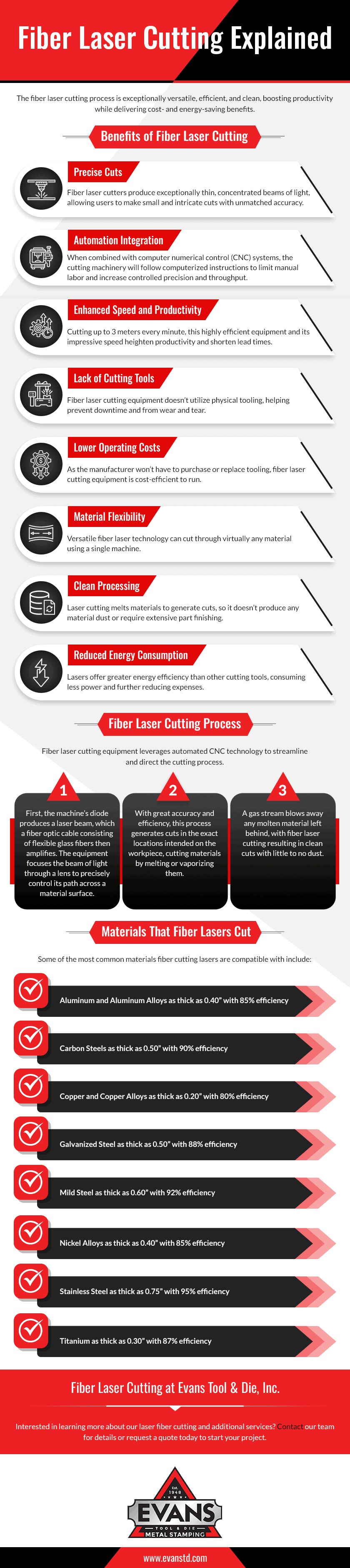
Fiber laser cutting is a precision cutting process that uses a narrow, intensely powerful, highly focused laser beam to make intricate, highly precise cuts by melting or vaporizing material along a programmed path. It’s valued for being versatile, efficient, and clean, helping boost productivity while also supporting cost and energy-saving benefits in many applications.
If you’re comparing cutting methods or deciding whether fiber laser cutting services fit your project, this guide covers how the process works, the key advantages, and which materials a fiber laser can cut.
Benefits of Fiber Laser Cutting
Choosing fiber laser cutting services over other cutting processes can offer significant advantages for production efficiency and overall product quality. Companies across multiple industries choose fiber laser technology for its:
Precise Cuts. Fiber laser cutters produce exceptionally thin, concentrated beams of light, allowing users to make small and intricate cuts with unmatched accuracy.
Automation Integration. Another factor enabling fiber laser cutting’s accuracy is its incorporation of automated technology. When combined with computer numerical control (CNC) systems, the cutting machinery will follow computerized instructions to limit manual labor and increase controlled precision and throughput.
Enhanced Speed and Productivity. Cutting up to 3 meters every minute, this highly efficient equipment and its impressive speed heighten productivity and shorten lead times.
Lack of Cutting Tools. Traditional cutting tools experience wear from friction-based processes and require periodic replacement. Fiber laser cutting equipment, however, doesn’t utilize physical tooling, helping prevent downtime.
Lower Operating Costs. As the manufacturer won’t have to purchase or replace tooling, fiber laser cutting equipment is cost-efficient to run, and service providers can pass those cost savings on to you.
Material Flexibility. Handling insulators and conductors alike, versatile fiber laser technology can cut through virtually any material using a single machine.
Clean Processing. Laser cutting melts materials to generate cuts, so it doesn’t produce any material dust or require extensive part finishing.
Reduced Energy Consumption. Lasers offer greater energy efficiency than other cutting tools, consuming less power and further reducing expenses.
Partnering with an experienced fiber laser cutting provider can help you get accurate parts at a competitive cost. For many projects, fiber laser cutting is one step in a broader workflow, and our metal fabrication services can support the next stage from cut parts to finished components.
Fiber Laser Cutting Process
Fiber laser cutting equipment leverages automated CNC technology to streamline and direct the cutting process. First, the machine’s diode produces a laser beam, which a fiber optic cable consisting of flexible glass fibers then amplifies. The equipment focuses the beam of light through a lens to precisely control its path across a material surface.
With great accuracy and efficiency, this process generates cuts in the exact locations intended on the workpiece, cutting materials by melting or vaporizing them. A gas stream blows away any molten material left behind, with fiber laser cutting resulting in clean cuts with little to no dust.
Keep in mind that, while the process is typically effective for metals that are multiple centimeters in thickness, the depth you can achieve with fiber laser cutting ultimately depends on:
Chosen Material Type and Thickness
Power and Speed of the Laser as it Passes over the Workpiece
Cutting Angle
Lens Quality
Materials That Fiber Lasers Cut
Versatile fiber cutting lasers can cut through an array of materials, though factors like density, hardness, reflectiveness, and thickness do have an impact on the process. Some of the most common materials fiber cutting lasers are compatible with include:
Aluminum and Aluminum alloys as thick as 0.40″ with 85% efficiency
Carbon Steels as thick as 0.50″ with 90% efficiency
Copper and Copper Alloys as thick as 0.20″ with 80% efficiency
Galvanized Steel as thick as 0.50″ with 88% efficiency
Mild Steel as thick as 0.60″ with 92% efficiency
Nickel Alloys as thick as 0.40″ with 85% efficiency
Stainless Steel as thick as 0.75″ with 95% efficiency
Titanium as thick as 0.30″ with 87% efficiency
Fiber Laser Cutting at Evans Tool & Die, Inc.
Fiber laser cutting is a highly effective precision cutting technique suited to diverse materials and applications. Evans has become a trusted name in machining, metal stamping, laser cutting, welding, assembly, finishing treatments, and tooling across industries. From low-volume orders to high-volume production runs, our tool makers and engineers will support you with reliable services and high-performance parts so you can build great products.
Our woman-owned, third-generation family business is ISO 9001:2015 certified, emphasizing quality in everything we do. In addition to fiber laser cutting technology, our in-house workshop is equipped with 67 punch presses of up to 1,000 tons and other advanced machinery. We’ll quickly and accurately produce, finish, package, and ship you precision components made per your unique part specifications and quality expectations.
Posted by Rick Kerbow on | Comments Off on What Materials Are Recommended for Laser Cutting?
Choosing the Best Materials for Laser Cutting
Thanks to recent advancements in laser cutting, it is now possible to cut even “difficult” materials with precision. The simplest machines can now cut large quantities of thin sheets or engrave any number of materials. Moderately powered laser cutters can be used on thin aluminum sheets, while more challenging materials like stainless steel can benefit from using more advanced machinery and cutting techniques. Today, we’re looking at the best materials to laser cut and their common uses.
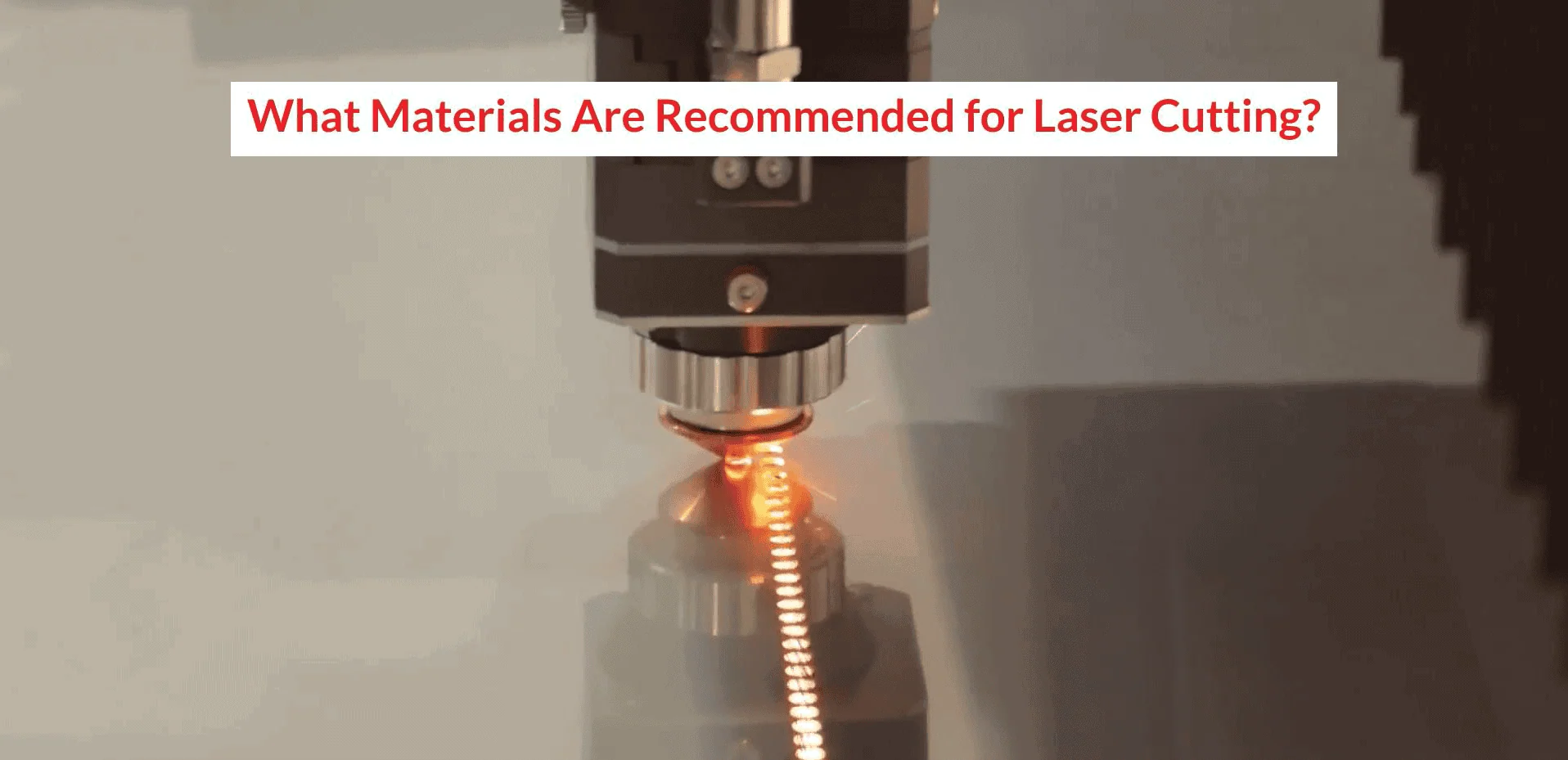
What Materials Are Recommended for Laser Cutting?
Laser cutting is a precise, efficient fabrication method used to handle a variety of materials. Understanding the compatibility of these laser-cutting materials with different equipment and cutting methods is key to achieving quality results.
Metal
Metals are strong and durable, making them suitable materials for a range of laser cutting and engraving project needs. While different types of lasers can offer their own advantages, fiber lasers are generally the best option for cutting metals, as they create a precise, narrow beam that can cleanly slice through metal without excessive heat spread. These can produce precise, clean cuts during fabrication, lending to industrial applications or more intricate designs.
Steel
Steel, particularly carbon steel, is the most common material choice for laser cutting. This material is suitable for many applications, from structural components to delicate automotive parts. Carbon steel is cut using fiber lasers, which can easily manage thicker sheets. High-power fiber lasers, for example, can cut carbon steel in thicknesses at a common maximum output of 100 mm or 3.93 inches. Using an oxidation melting cutting mechanism allows operators to better control the slit of carbon steel, enabling cuts as fine as 0.1 mm.
Steel also comes in a few varieties, each with specific uses:
Cold Rolled Steel. Known for its smooth finish, colled roll steel is easy to work with and widely used in laser cutting for applications requiring precision.
Hot Rolled Steel. This is a stronger steel material, making it suitable for projects with less critical surface finish needs.
Galvanized Steel. This steel is highly resistant to corrosion. It’s frequently used in outdoor applications to promote durability in different structures.
Stainless Steel
Stainless steel is a highly versatile material, with laser-cutting applications ranging from automotive parts to advertising signage. Manufacturers can use fiber laser machines to efficiently cut stainless steel sheets and tubing. These machines give operators better control over the cutting process, significantly reducing the heat-affected zone of the cutting edge. This helps maintain the material’s corrosion resistance and mechanical properties while minimizing heat impact on the surrounding metal.
Aluminum
Aluminum is lightweight and corrosion-resistant, which is extremely valuable in aeronautics and automotive applications. However, reflective materials like aluminum can deflect laser beams due to their lower absorption rate. Small cracks can also appear on the surface when cutting certain aluminum alloys. Using fiber lasers allows operators to adjust power levels during the cutting process. Auxiliary gases such as nitrogen can be used to blow away molten material during the laser cutting process and protect the aluminum’s characteristic silvery sheen.
Brass and Copper
Laser-cut copper and brass are known for their high reflectivity and thermal conductivity, making them ideal for use in heat exchangers and various electronics. CO2 lasers are less effective at cutting reflective materials like these. Fiber lasers produce a wavelength of about 1.06 – 1.08 µm, which focuses down to a much smaller point. This results in a greater power density, allowing these lasers to cut brass and copper materials with ease.
At high power densities, copper and brass quickly reach a molten state, enabling more efficient cutting. Using nitrogen as an auxiliary gas helps maintain a clean cut without requiring oxidation.
Titanium
Titanium’s versatility and strength make it an ideal laser-cutting material for aerospace, medical, and other high-performance applications. Titanium responds well to reactive laser-cutting machines, which can convert focused laser beams into heat energy. Argon is ideal, but nitrogen can also be used as an auxiliary gas to create a rapid chemical reaction to increase cutting speeds.
Controlling the reaction is crucial to avoid oxidation at the edges. Alternatively, using air as the auxiliary gas can help prevent burning and ensure the cut edges remain clean.
PVC Coatings for Stainless Steel
Stainless steel may require a PVC coating to protect the surface during manufacturing. This PVC protects polished and finished stainless steel in certain applications, such as weatherproof paneling. However, these coatings can also emit toxic chemical fumes during cutting, posing a potential hazard to operators and the environment. In order to work with PVC-coated stainless steel, safety features such as air filtration and proper ventilation are necessary.
Laser Cutting at Evans Tool & Die
While numerous materials benefit from laser cutting, it’s important to implement specific techniques and equipment for optimal results. At Evans Tool & Die, we specialize in precision laser cutting for projects across many different industries. Our ISO 9001:2015 certification and long-running history of customer satisfaction reflect our commitment to quality and excellence. Our experienced team is here to assist with all aspects of your project, from design to assembly.
If you’re looking to streamline your production and supply chain, contact us today to receive a quote on your next laser-cutting project.
Posted by Rick Kerbow on | Comments Off on How Laser Cutting is Used in the Defense Industry
The military & defense industry relies on mission-critical equipment and vehicles for ground, air, and water-based operations. The parts and assemblies that go into everything from trucks and transport aircraft to satellite equipment must be manufactured on time and without errors to meet MIL-SPEC and performance requirements.
Industrial laser cutting is widely used in defense manufacturing to produce military parts and precision components. When selecting laser cutting services from a partner for military applications, what matters most is consistent cut quality, tight tolerances at scale, and the ability to work with diverse materials.
Here, we’ll look at some military and defense applications for laser cutting, general material options, and the advantages this technology offers.
Click to Expand
Manufacturing Complex Military Parts
Laser cutting is a versatile defense manufacturing technique that can be used for complex part geometries with intricate cuts and fine features, or for large parts with critical dimensions and tight tolerances.
Examples of military and defense applications are:
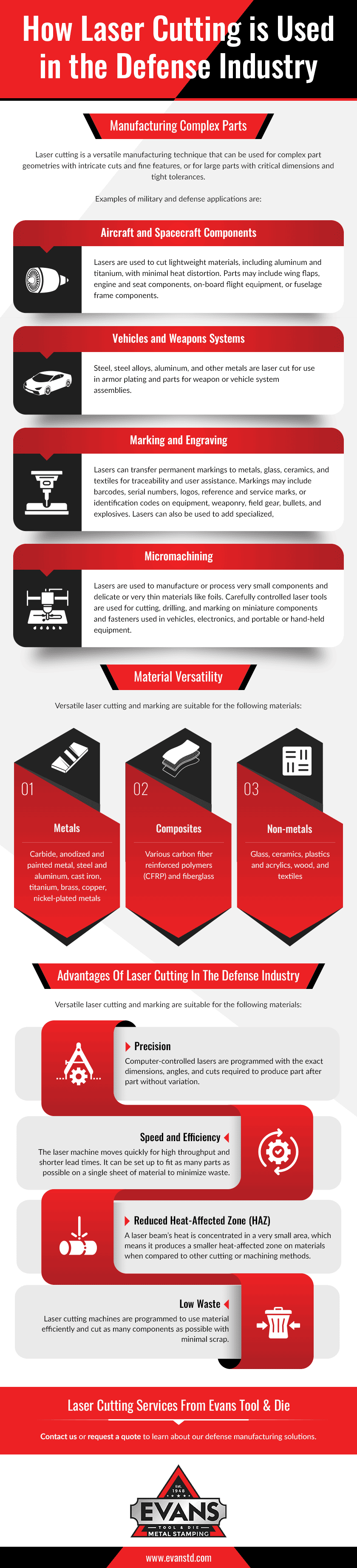
Aircraft and spacecraft components. Lasers are used to cut lightweight materials, including aluminum and titanium, with minimal heat distortion. Parts may include wing flaps, engine and seat components, on-board flight equipment, or fuselage frame components.
Vehicles and weapons systems. Steel, steel alloys, aluminum, and other metals are laser cut for use in armor plating and parts for weapon or vehicle system assemblies.
Marking and engraving. Lasers can transfer permanent markings to metals, glass, ceramics, and textiles for traceability and user assistance. Markings may include barcodes, serial numbers, logos, reference and service marks, or identification codes on equipment, weaponry, field gear, bullets, and explosives. Lasers can also be used to add specialized, high-performance textures.
Micromachining. Lasers are used to manufacture or process very small components and delicate or very thin materials like foils. Carefully controlled laser tools are used for cutting, drilling, and marking on miniature components and fasteners used in vehicles, electronics, and portable or hand-held equipment.
Material Versatility
Defense and military parts, gear, and equipment contain many different types of materials including metals, non-metals, and textiles. Lasers are capable of marking, embossing, and cutting substrates in a range of thicknesses. Depending on the application, both fiber and CO2 lasers give excellent cutting and marking results.
Versatile laser cutting and marking are suitable for the following materials:
Metals: Carbide, anodized and painted metal, steel and aluminum, cast iron, titanium, brass, copper, nickel-plated metals
Composites: Various carbon fiber reinforced polymers (CFRP) and fiberglass
Non-metals: Glass, ceramics, plastics and acrylics, wood, and textiles
Advantages Of Industrial Laser Cutting In The Defense Industry
Equipment and devices used in military and defense operations must be well-made and reliable. That means the parts, assemblies, and subassemblies that go into them must also meet strict specifications and tolerances so they fit and function correctly. Laser cutting, marking, and processing excel at meeting this goal.
Laser cutting offers these advantages for military manufacturing:
Precision. Computer-controlled lasers are programmed with the exact dimensions, angles, and cuts required to produce part after part without variation. Lasers also leave no tool marks or gouges on surfaces, which can affect tolerances or performance.
Speed and efficiency. The laser machine moves quickly for high throughput and shorter lead times. It can be set up to fit as many parts as possible on a single sheet of material to minimize waste. Lasers generate sufficient power to melt or vaporize the material so cuts, holes, and markings have no rough edges and need no extra finishing, like deburring or sanding.
Reduced heat-affected zone (HAZ). A laser beam’s heat is concentrated in a very small area, which means it produces a smaller heat-affected zone on materials when compared to other cutting or machining methods. A smaller HAZ results in less distortion at the edges and does not compromise the structural integrity of the material.
Low waste. Laser cutting machines are programmed to use material efficiently and cut as many components as possible with minimal scrap. The material is carefully aligned on the cutting bed so all cuts are extremely accurate with very few errors. Integrated vision systems and cameras can also be used to monitor and adjust the laser’s path on the fly.
Laser Cutting Services From Evans Tool & Die
Evans Tool & Die provides laser cutting services for precision components in the military and defense industry, and more. We also offer military metal stamping services, metal fabrication, welding, electroplating, and finishing services for a complete solution to your manufacturing needs.
We are a family-owned and operated business and have been committed to integrity, quality, and accountability in our work since 1948. Our team serves the Conyers, GA area and beyond.
Have questions? Contact our team to speak with an expert to learn more about our defense manufacturing solutions, or request a quote to get started.
Posted by Rick Kerbow on | Comments Off on What are the Different Types of Laser Cutting?
Industrial laser cutting quickly produces uniform metal components that require minimal finishing. It is commonly used with metals and alloy metals, as well as ceramics, some plastics, glass, and textiles in different thicknesses. Lasers can also be used for engraving, annealing, and other operations.
Here, we’ll look at how laser cutting works and present four common types of lasers used in industry. We’ll also look at some typical laser cutting applications.
What Is Laser Cutting?
“Laser” is an acronym for Light Amplification by Stimulated Emission of Radiation. Essentially, the laser cutting process involves the use of concentrated beams of light to cut, melt, and vaporize material. This process is suitable for cutting materials in various thicknesses and can be used to create both simple and complex shapes.
Laser beams are generated when electrons in optical materials like crystal, gas, or glass absorb energy from light or an electric current. The excited electrons emit light energy, which is then directed through material that amplifies it. Lasers are also “doped” with different elements to produce desired wavelengths.
Because it is a non-contact process, laser cutting will not scorch, scratch, or leave tool marks on workpieces. Cuts are clean, with no burrs or rough edges; therefore, they require little to no additional finishing such as deburring or grinding.
Click to Expand
What Are the Different Types of Laser Cutting?
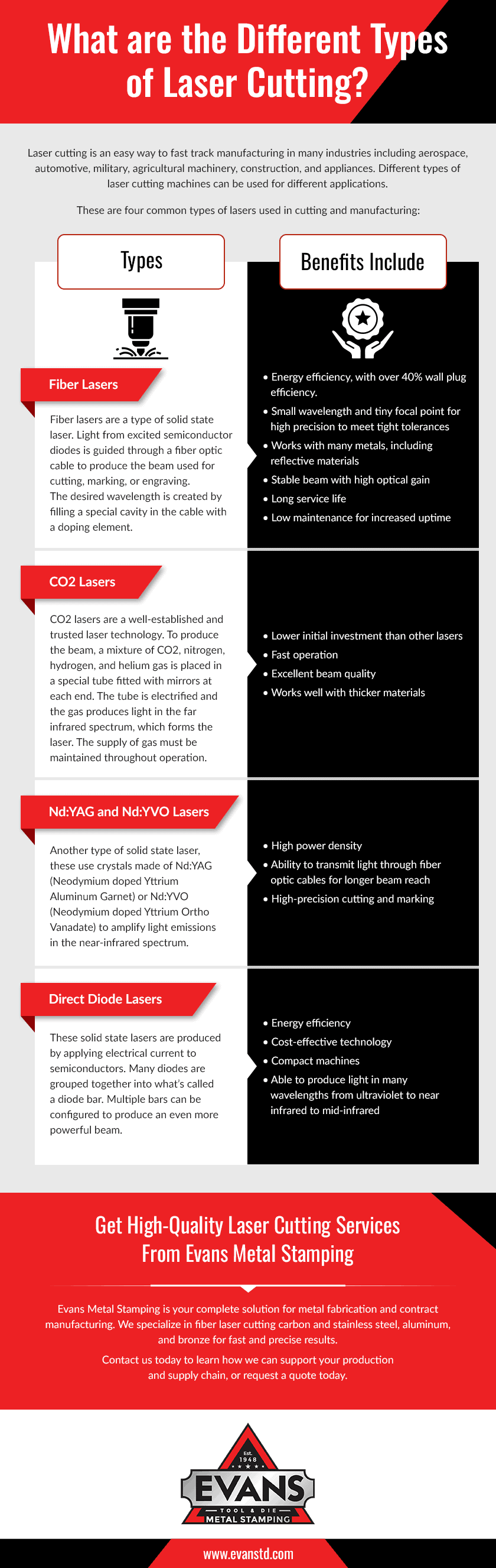
Laser cutting is an easy way to fast track manufacturing in many industries including aerospace, automotive, military, agricultural machinery, construction, and appliances. Different types of laser cutting machines can be used for different applications.
These are four common types of lasers used in cutting and manufacturing:
Fiber Laser Cutting
Fiber lasers are a type of solid-state laser. Light from excited semiconductor diodes is guided through a fiber optic cable to produce the beam used for cutting, marking, or engraving. The desired wavelength is created by filling a special cavity in the cable with a doping element.
Benefits include:
Energy efficiency, with over 40% wall plug efficiency
Small wavelength and tiny focal point for high precision to meet tight tolerances
Works with many metals, including reflective materials
Stable beam with high optical gain
Long service life
Low maintenance for increased uptime
Fiber lasers are well-suited for thinner materials. They are often used for marking, annealing, engraving, cutting, and welding. Common materials used with fiber lasers include metal, glass, ceramics, composite polymers, and plastics.
CO2 Laser Cutting
CO2 lasers are a well-established and trusted laser technology. To produce the beam, a mixture of CO2, nitrogen, hydrogen, and helium gas is placed in a special tube fitted with mirrors at each end. The tube is electrified and the gas produces light in the far infrared spectrum, which forms the laser. The supply of gas must be maintained throughout operation.
Benefits include:
Lower initial investment than other lasers
Fast operation
Excellent beam quality
Works well with thicker materials
CO2 lasers are often used with non-metals including paper and wood. They can also be used with acrylics, leather, textiles, and food products, as well as for cutting different steel materials.
Nd:YAG and Nd:YVO Laser Cutting
Another type of solid state laser, these use crystals made of Nd:YAG (Neodymium doped Yttrium Aluminum Garnet) or Nd:YVO (Neodymium doped Yttrium Ortho Vanadate) to amplify light emissions in the near-infrared spectrum.
Benefits include:
High power density
Ability to transmit light through fiber optic cables for longer beam reach
High-precision cutting and marking
Nd:YAG and Nd:YVO lasers are frequently used for aerospace and other applications that use titanium, nickel, and steel. They are also used to mark and engrave very hard materials including polycarbonates and ceramics.
Direct Diode Laser Cutting
These solid state lasers are produced by applying electrical current to semiconductors. Many diodes are grouped together into what’s called a diode bar. Multiple bars can be configured to produce an even more powerful beam.
Benefits include:
Energy efficiency
Cost-effective technology
Compact machines
Able to produce light in many wavelengths from ultraviolet to near infrared to mid-infrared
Diode lasers can weld, cut, and mark sheets of steel and aluminum, as well as polymethylmethacrylate and polycarbonate. There may be limits on the thickness of materials that can be cut with a diode laser.
Get High-Quality Laser Cutting Services From Evans Metal Stamping
Evans Metal Stamping is your complete solution for metal fabrication, such as metal stamping and fiber laser cutting carbon and stainless steel, aluminum, and bronze for fast and precise results.
Posted by Rick Kerbow on | Comments Off on Laser Cutting vs. Laser Engraving vs. Laser Marking: Understanding the Differences
Click to Expand
A laser is a highly focused beam of light that emits a specific wavelength and heat. A system of mirrors and lenses in the laser machine guides and concentrates the beam into a predetermined focal point. Heat given off by the laser hits a material substrate to permanently alter it, by marking or etching its surface, or by cutting through it completely.
Depending on the type of laser (i.e., CO2, fiber, etc.), its wavelength, and the power level, lasers can be used for many creative purposes, commercial products, and manufacturing processes including welding, cutting, etching, annealing, and more.
Here we’ll look at the differences between laser cutting, engraving, and marking operations.
Laser Cutting
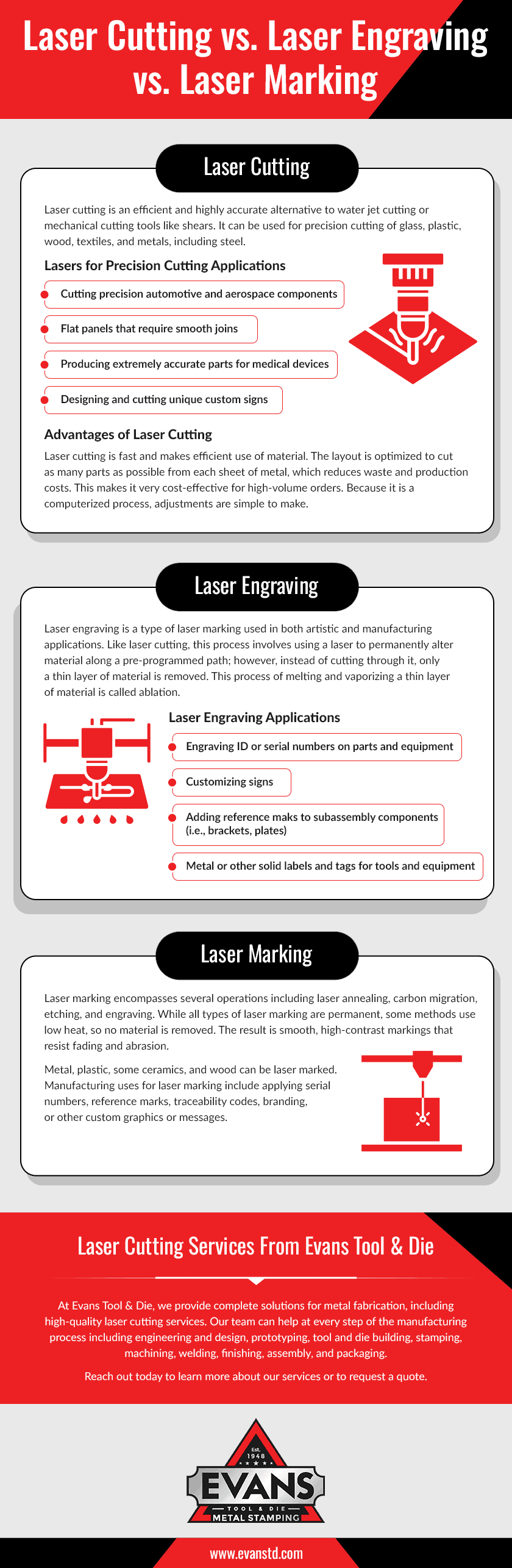
Laser cutting is an efficient and highly accurate alternative to water jet cutting or mechanical cutting tools like shears. It can be used for precision cutting of glass, plastic, wood, textiles, and metals, including steel.
The laser beam is focused and guided by a system of optical components inside the laser machine, directing the beam to a point on the material. Heat from the laser melts the material enough to burn or melt through it. Different materials require different types and strengths of lasers. For example, a powerful CO2 laser is required to cut through steel.
After making an initial puncture in the material, the beam is moved according to the desired pattern and cuts a path. Laser cutting machines are controlled by computerized motion control systems that use G-code programming to create specific cuts, features, and shapes. Laser cuts can be simple or intricate. A laser can also be used to drill holes with great precision.
Lasers for Precision Cutting Applications
Laser cutting is used in many manufacturing applications. Some examples include:
Cutting precision automotive and aerospace components
Flat panels that require smooth joins
Producing extremely accurate parts for medical devices
Designing and cutting unique custom signs
Advantages of Laser Cutting
Laser cutting is fast and makes efficient use of material. The layout is optimized to cut as many parts as possible from each sheet of metal, which reduces waste and production costs. This makes it very cost-effective for high-volume orders. Because it is a computerized process, adjustments are simple to make.
The beam can be focused on a highly concentrated and tiny focal point, and exact coordinates are programmed into the machine, so it’s possible to achieve extremely tight tolerances for cuts and shapes. As non-contact tools, lasers don’t leave stray marks, scorch, or otherwise damage material outside of designated areas on the workpiece. What’s more, because the material is melted and vaporized, cuts and holes are usually smooth and clean, requiring little to no additional finishing.
Laser Engraving
Laser engraving is a type of laser marking used in both artistic and manufacturing applications. Like laser cutting, this process involves using a laser to permanently alter material along a pre-programmed path; however, instead of cutting through it, only a thin layer of material is removed. This process of melting and vaporizing a thin layer of material is called ablation.
Solid state fiber lasers are often used for engraving. Materials including metal, stone, brick, wood, acrylic, fabric, and cardboard can be laser engraved. Depending on the wavelength and other parameters, engravings can be raised, shallow, or deep. Most engravings are between .0001 in. and .005 in. deep.
Laser engraving applications
This process is used for applications including:
Engraving ID or serial numbers on parts and equipment
Customizing signs
Adding reference marks to subassembly components (i.e., brackets, plates)
Metal or other solid labels and tags for tools and equipment
Laser Marking
Laser marking encompasses several operations including laser annealing, carbon migration, etching, and engraving. While all types of laser marking are permanent, some methods use low heat, so no material is removed. The result is smooth, high-contrast markings that resist fading and abrasion.
Metal, plastic, some ceramics, and wood can be laser marked. Manufacturing uses for laser marking include applying serial numbers, reference marks, traceability codes, branding, or other custom graphics or messages.
Laser Cutting Services From Evans Tool & Die
At Evans Tool & Die, we provide complete solutions for metal fabrication, including high-quality laser cutting services. Our team can help at every step of the manufacturing process including engineering and design, prototyping, tool and die building, stamping, machining, welding, finishing, assembly, and packaging.
Reach out today to learn more about our services or to request a quote.
Evans Companies, Inc uses cookies to give you a more personalized experience on our website. If you continue to use our services, we assume that you accept such use. Learn more about cookies and how you can refuse them on our Privacy Policy page.