Posted by Rick Kerbow on | Comments Off on Progressive Die Tooling: The Backbone of Efficient Manufacturing
Click to Expand
Progressive die stamping is a versatile and efficient manufacturing process for many industries. Custom tool and die sets are engineered to stamp parts from metal strips as they feed through a press.
Here, we’ll look at the progressive stamping process, the components that make up progressive die tooling, and the benefits this process offers for OEMs, their suppliers, and aftermarket manufacturers.
What is Progressive Die Tooling?
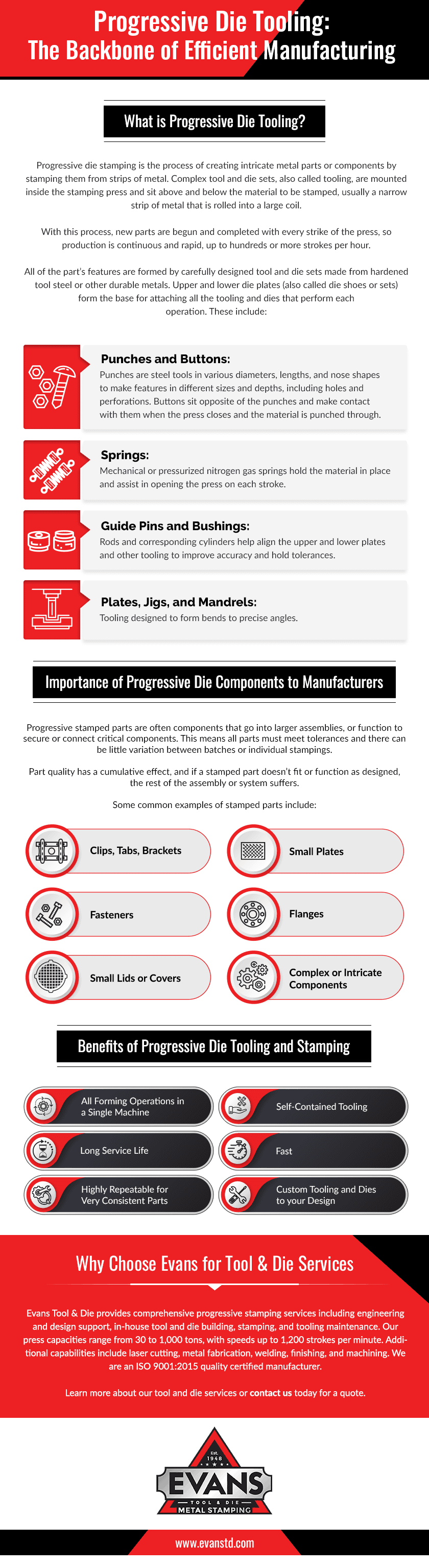
Progressive die stamping is the process of creating intricate metal parts or components by stamping them from strips of metal. Complex tool and die sets, also called tooling, are mounted inside the stamping press and sit above and below the material to be stamped, usually a narrow strip of metal that is rolled into a large coil.
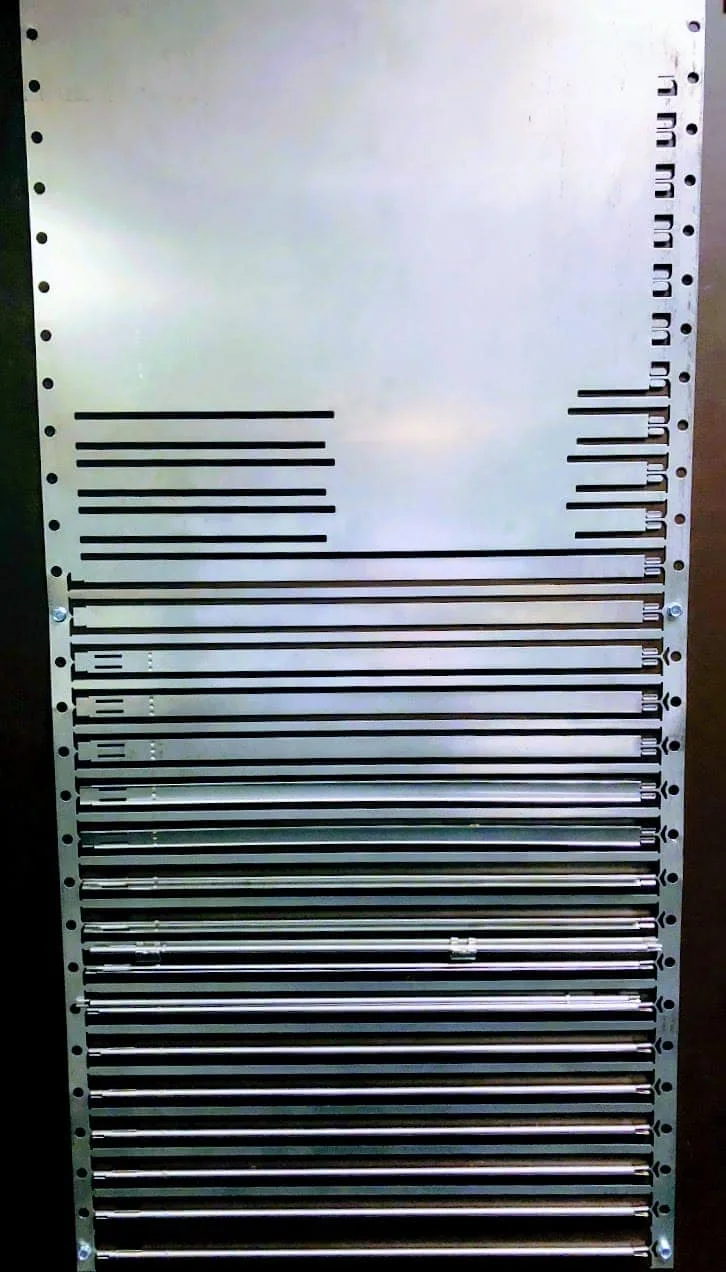
The idea behind progressive stamping is that each operation required to create a finished part is laid out in sequence in a single tool and die set. The strip advances with each stroke of the press, and it stops and is struck at each station. After each stamping passes through all of the stations, they are complete with all features formed. Parts can be designed to remain attached to the carrier strip or knocked out and collected in a bin.
With this process, new parts are begun and completed with every strike of the press, so production is continuous and rapid, up to hundreds or more strokes per hour.
All of the part’s features are formed by carefully designed tool and die sets made from hardened tool steel or other durable metals. Upper and lower die plates (also called die shoes or sets) form the base for attaching all the tooling and dies that perform each operation. These include:
Punches and Buttons: Punches are steel tools in various diameters, lengths, and nose shapes to make features in different sizes and depths, including holes and perforations. Buttons sit opposite of the punches and make contact with them when the press closes and the material is punched through.
Springs: Mechanical or pressurized nitrogen gas springs hold the material in place and assist in opening the press on each stroke
Guide Pins and Bushings: Rods and corresponding cylinders help align the upper and lower plates and other tooling to improve accuracy and hold tolerances.
Plates, Jigs, and Mandrels: Tooling designed to form bends to precise angles.
Importance of Prog Die Components to Manufacturers
Progressive stamped parts are often components that go into larger assemblies, or function to secure or connect critical components. This means all parts must meet tolerances and there can be little variation between batches or individual stampings.
Part quality has a cumulative effect, and if a stamped part doesn’t fit or function as designed, the rest of the assembly or system suffers.
Some common examples of stamped parts include:
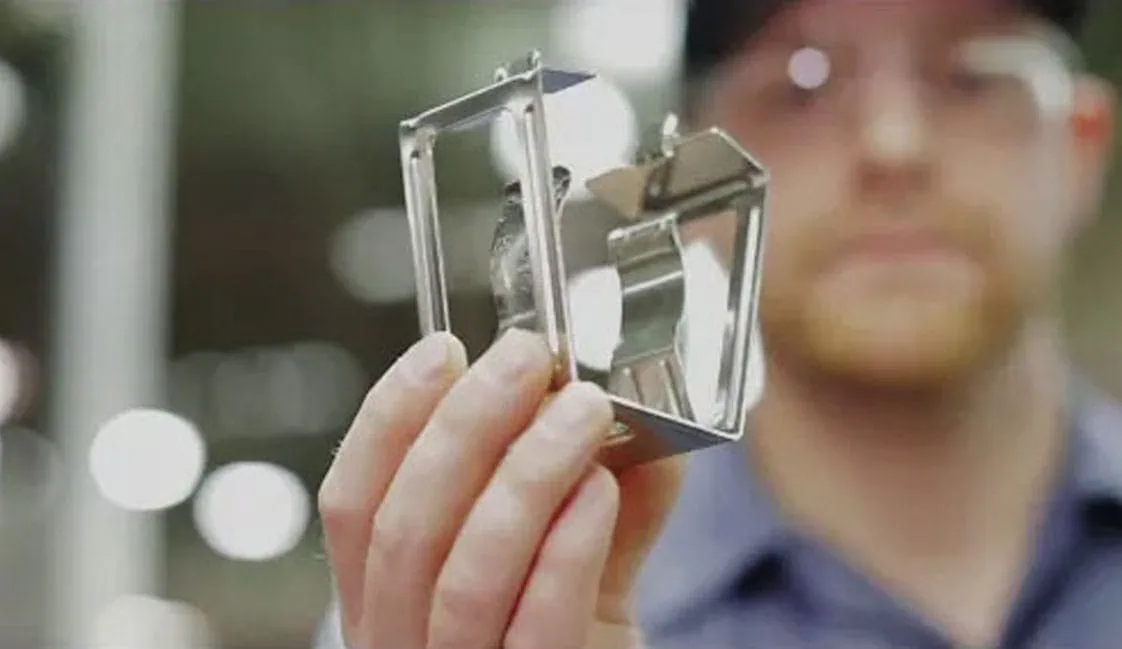
Clips, Tabs, Brackets
Small Plates
Fasteners
Flanges
Small Lids or Covers
Complex or Intricate Components
Progressive stamping works with material as thin as foil up to a half inch or more in thickness. Many grades of steel and alloys, aluminum, copper, brass, and bronze can be stamped with excellent results.
Benefits of Progressive Die Tooling and Stamping
Because progressive die tooling is custom-designed and built for each stamping project, stamping offers many benefits to manufacturers such as:
All Forming Operations in a Single Machine: There is no need to move between presses because the process moves from metal strips to completed parts as it travels through the machine. This means less handling and labor.
Self-Contained Tooling: All of the tooling and dies are attached to the plates inside the press so there is no changeover or adjustments to the tooling during stamping.
Long Service Life: Tooling and dies are usually built with tool steel or other hard, durable metals. With proper maintenance, they can last for thousands or millions of cycles. This is especially beneficial to companies that enter long-term or extremely high volume contracts, or those who have vendor-managed inventory (VMI) agreements with their stamper.
Fast: Progressive stamping presses move rapidly, with a newly completed part ejected with each stroke of the press until the batch is completed.
Highly Repeatable for Very Consistent Parts: The continuous feed of the material through self-contained tooling means variation from part to part and from batch to batch is minimal. The result is consistent quality and less scrap than other methods.
Custom Tooling and Dies to your Design: Stampers that offer in-house tooling and die design and manufacturing have a full understanding of your goals for the part and its end use. This comprehensive, end-to-end solution reduces the risk of miscommunication over the course of the project.
Why Choose Evans for Tool & Die Services
Evans Tool & Die provides comprehensive progressive stamping services including engineering and design support, in-house tool and die building, stamping, and tooling maintenance. Our press capacities range from 30 to 1,000 tons, with speeds up to 1,200 strokes per minute. Additional capabilities include laser cutting, metal fabrication, welding, finishing, and machining. We are an ISO 9001:2015 quality certified manufacturer.
Posted by Rick Kerbow on | Comments Off on Benefits of Modern Progressive Metal Stamping and Hand Transfer Stamping in Manufacturing
Metal stamping is a type of metal working that has been around for decades. It involves shaping various metals into specific shapes or parts through multiple stages of compressive deformation. The stamping process works by applying an external force over a single work piece or metal sheet which can be made up of different alloys, each having their own degree of malleability.
Various types of metal stamping materials can be used in order to produce stamped metal parts and goods with greater strength, durability, mass-proportion, and performance without changing the weight significantly.
Stamped metal parts play a major role in today’s manufacturing
Products produced by metal stamping companies like Evans Metal Stamping, are part of virtually every part of our lives where metal parts are used. From medical supply tooling to construction tools to decorative emblems and major structural components in automobile manufacturing… Metal stamping plays a major role in production.
Manufacturing has become highly specialized with the evolution of various techniques, advanced stamping presses and different materials used for stamping. By using the finest metals available for stamping, manufacturers can provide customers with high quality products in mass quantities and in a timely manner.
Most common types of metal stamping used when stamping products
The two most commonly used techniques used in modern day manufacturing are progressive die metal stamping and transfer die stamping. Both of these techniques have specific processes that make them unique. Depending on the size of stamped work piece, complexity, material and quantity needed, the manufacturer decides which technique to use.
The progressive stamping process at Evans Tool & Die
Progressive metal stamping is a manufacturing process involving the progressive deformation of an object by successively applying compressive force. It has also been known to be referred to as progressive die sinking and owes its name to the fact that it involves a series of dies (some would call them punches) which, through successive action, progressively form the product.
Stamping can necessitate low and high tonnage presses, using significant energy and large or small dies. The products are usually made from metal rolled up on heavy coils . The coiled metal is fed through the punch press and the part is stamped in progressive stages through the die that is bolted into the press. Progressive stamping will produce a significantly higher volume of parts at a much faster rate than hand transfer stamping.
At Evans Metal Stamping, Inc, we can assist with prototyping or run high volume jobs. Our metal presses can handle 30 to 1,000 tons at speeds up to 1,200 cycles per minute. When your project calls for high quality, precision stamping, Evans can handle your project no matter how big or time sensitive it may be.
Our capabilities in producing precision, high quality and high-volume runs are due to the state of the art machinery we use and our highly trained and experienced technicians. Our stamping machinery includes but is not limited to:
39 conventional presses from 30 to 1000 ton
27 high speed (1200 SPM) Bruderer presses from 40 to 125 ton
6 brake presses from 150 to 250 ton
3 shears
Hand transfer metal stamping
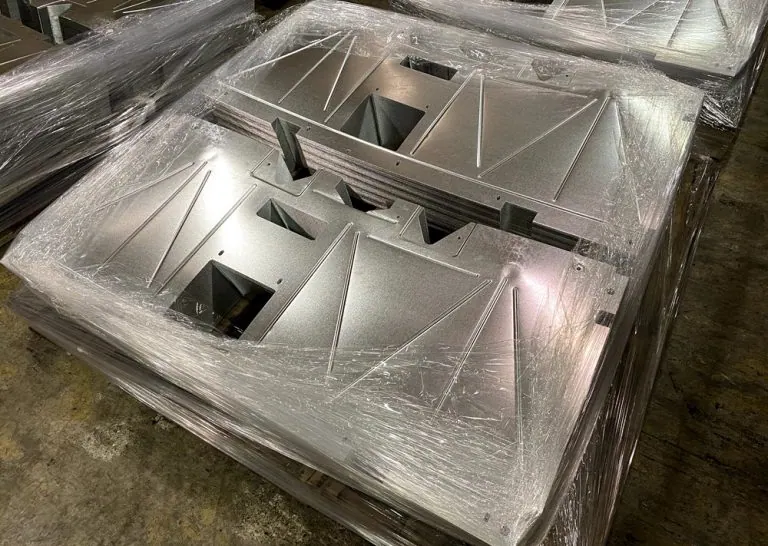
Hand transfer metal stamping is used to place individual pieces or parts of the design onto sheet metal, or stamp more heavy-duty single hit designs. Transfer die stamping is similar to progressive die stamping, but the part is free from the metal strip. Hand transfer metal stamping can also be used to add detail into already existing designs or produce larger components such as industrial generator pans which may require moving the workpiece from die to multiple dies.
Hand transfer metal stamping has been around for centuries and still used today by metal fabricators all over the world.
Evans has the capacity to produce high volumes of industrial type metal parts due to our decades of experience and machinery used to produce the parts.
Evans Metal Stamping is proudly made and produced in the USA
Evans is a one-stop shop, made in the USA, Preferred Provider of precision Tool & Die builds and progressive and hand transfer metal stamping products. We provide complete design and engineering processes, assembly, and packaging. We provide risk management solutions to the overseas supply chain breakdowns for OEMs by localizing supply chains with high quality, seamless logistics and hands on supply chain control.
Posted by Rick Kerbow on | Comments Off on Stamping out a Robotic Surgical Instrument
In 2012, Evans Tool & Die Shop Supervisor Dick Ankeny was tasked with building a die for one specific part of a robotic surgical instrument. The specifications for the part required tolerances to be within .005”. The part had to be made from stainless steel, because the part itself would actually be inserted into surgical patients’ bodies, as a piece of a robotic surgical instrument.
The Challenge of a Surgical Instrument
The manufacturer of the surgical instrument had created technical drawings for the part; however, we still had to evaluate the specifications to determine if the part could be made according to the customer’s drawings. After a few iterations, the engineers finalized the approach and the project moved from design and engineering into toolmaking so the team could begin building the die.
Dick Ankeny, a Toolmaker who has worked for Evans for 28 years, said this of the project: “The hardest part was creating such a small cylindrical shape from a flat piece of stainless steel to such fine tolerances.”
Stainless Steel
According to Ankeny, stainless steel is harder to work with, not as forgiving on tooling, harder to stamp, form, etc. But the surgical instrument had to be stainless steel, because the part would actually be inserted into the bodies of surgical patients. Similar to the materials used food utensils in restaurants, stainless steel is one of the most commonly used metal alloys in the manufacture of surgical implements.
Austenitic 316 steel is a type of stainless steel used often, and is referred to as “surgical steel”. This is because it is a tough metal that is very resistant to corrosion. Stainless steel can withstand temperatures as high as 400°C, meaning it can be sterilized easily in an autoclave at 180°C. Stainless steel also has the benefit of being almost as tough and hard-wearing as carbon steel.
The Tool & Die Building Process
Once the drawings were finalized, we started building the tool. The process of making this die consisted of the following high-level steps:
The engineers create the technical design (commonly called “prints”) for the surgical instrument as part of our design and engineering process.
The Engineers determine which steel goes into each die, and then we order the steel for die. There are four different kinds of steel used in this particular die:
A2 – basic tool steel – easy to machine, treat, and grind
D2 – a step above A2, but a more durable steel
CPM10V – very hard steel, high tensile strength
M4 – also very hard steel, with high tensile strength
The Toolmaker squares the steel, puts any drilled holes or tapped holes needed, mills in the required dimensions, leaving grind stock.
What “leaving grind stock” means is that, for example, if the requirement for a certain size of block is 3” x 2” then we will actually mill the block to 3.020” x 2.020”.
Then we put drilled and tapped holes on the block, and heat treat the block to harden it. This type of build is a core part of our tool and die services.
These steps sound relatively clear and simple; however, “It took us more than nine months to build this die”, said Ankeny.
Progressive Stamping the Part
Ankeny described the progressive stamping process: “Each individual part starts with a single sheet of coiled stainless steel. We created 29 stamp progressions in the tool, starting with pilot holes. Each piece of flat steel moves forward at 20 strokes (hits) per minute, so we ended up producing just under 20 parts per minute once the metal stamp is rolling.” When creating this, it was important we used a high grade metal stamping lubricant.
Dick added, “This one was the second most challenging part I’ve ever built. We pulled that die out so many times I can’t remember!”
We built the die, ran many tests until the part met the final specifications and the customer was satisfied with the quality of the resulting part for their surgical instrument. Then our customer took the die and began manufacturing the part in their manufacturing facility.
“We can run the part or our customer can run the part. Either way is OK with us,” added Randall Stanfield, Engineering Project Director.
Testing & Measuring to Very High Tolerances
When the final part is rolled into its proper shape, we used a pin gauge to test it. One of the tests for quality was to drop a 3/16” pin straight through the cylinder. The specifications required tolerances of less than five thousandths of an inch (.005”), and the pin gauge had to move through the interior or the cylinder unimpeded. That’s just one test that the final part must pass. Some of the other challenging metrics included:
Springback. When you bend steel, it naturally resists, and bends back slightly towards its original shape. Because of the exacting specifications of this part, we had to design and build the tool to keep springback to a minimum.
Swedging. Swedging of the steel, to maintain the right thickness, was a challenge. We were required to change the steel to the required thickness (tolerances within .0005”) while having it maintain that exact thickness throughout the progressive stamping process while it’s running. Such requirements push the tooling to the limit of swedging the metal togethe
“Then we had to punch a tiny hole in it. Big challenge!” added Ankeny.
We used a Micrometer and pin gauges (3/16”) to measure the actual achieved tolerances and measurements. If the measurements don’t meet the specifications, we change radius of the tooling on the die. Then we complete another test run. There were close to 100 components in the die, including the top and bottom. In this case, “changing” the radius of the tooling on the die means adjustments of thousandths of inches.
Part of our core values
“Creating custom, difficult, challenging parts like this surgical instrument is a big part of our everyday operation,” adds Evans CEO Dee Barnes. “In the end, whether we produce the parts or our customer produces the parts, we know we’ve helped our customer get the end result they required.”
Evans Companies, Inc uses cookies to give you a more personalized experience on our website. If you continue to use our services, we assume that you accept such use. Learn more about cookies and how you can refuse them on our Privacy Policy page.